

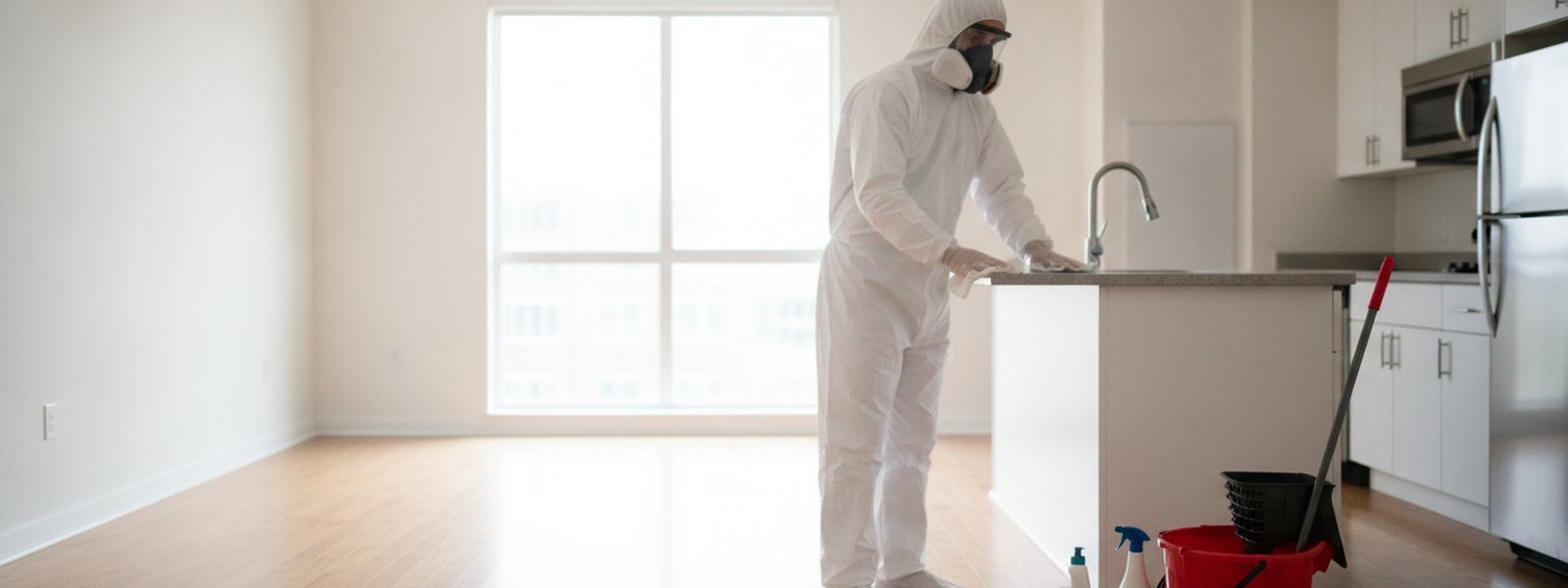
Biohazard Cleanup Company Valuation
29 valuation methods · 43 industries · Results in under 10 minutes
In short
A smaller biohazard cleanup company is valued mainly on seller's discretionary earnings: EBITDA plus the owner's pay, times the median multiple from small-business sales in VA's data. Referral sources, insurance billing and crews that run without the owner shape what buyers pay.
Who this is for
Owners of biohazard, trauma, crime scene, unattended death and hoarding cleanup companies preparing to sell, bring in a partner or plan succession, and buyers who need referral-driven earnings read alongside insurance billing and crew depth.
How is a biohazard cleanup company valued?
For a smaller environmental services company, VA puts the most weight on seller's discretionary earnings, EBITDA plus the owner's pay, times the median multiple from small-business sales of environmental services companies in its data. A discounted cash flow, comparable companies and precedent transactions carry the rest. A larger company is valued on those three alone. Earnings are taken after the add-backs you confirm, and an asset floor keeps the result above what the company's own assets would recover. This tool is informational only. Output is driven by your inputs and does not constitute a formal appraisal or certified valuation.
What drives the value of a biohazard cleanup company?
- Referral sources such as police, funeral homes, property managers, insurers and restoration companies, and how widely the work is spread across them
- Insurance billing: how much of the revenue insurers pay, and how long they take
- Crews trained in bloodborne pathogen and waste handling, on call day and night
- Medical waste disposal contracts and permits
- Commercial accounts such as property managers and facility operators that bring in work every year
- An owner who is not the only person on call
What lowers the value of a biohazard cleanup company?
- Calls that come through the owner's own phone and relationships
- One referral source sending most of the work
- Insurers that pay slowly or cut invoices
- Waste disposal permits or contracts in the owner's name
How much is a biohazard cleanup company worth? A worked example
A cleanup company, by discounted cash flow
Take a biohazard cleanup company with $2 M of revenue and an 18% EBITDA margin, or $360 K of EBITDA. Assume revenue grows 5% a year for five years, capital spending and depreciation each run at 3% of revenue, working capital takes 10% of each year's added revenue and tax is 25%. Cash flows are discounted at 18%, the lowest rate VA uses for a company this size, with 2.5% growth after year five. VA's discounted cash flow gives about $1.56 M before debt, or 4.3× EBITDA. With revenue growing 2% a year instead, it comes to about $1.43 M. In a full report for a company this size, the value from seller's discretionary earnings and the median multiple from small-business sales carries the most weight.
Illustrative figures from VA's discounted cash flow alone, on the assumptions stated. A full report blends it with the industry's other methods, such as comparable companies and precedent transactions.
Value your biohazard cleanup company in under 10 minutes
- 1.Upload your financial statements, or type the figures in.
- 2.Confirm the add-backs and the industry details the model asks for.
- 3.Get a valuation range, the methods behind it and a PDF memorandum.
Which numbers matter most?
Seller's discretionary earnings
EBITDA plus the owner's own pay and perks. VA uses the pay your statements or confirmed add-backs show; when none is stated, it estimates a working owner's pay for your industry.
Median sale multiple
The median multiple of seller's discretionary earnings in small-business sales of environmental services companies in VA's data. With too few sales on record, VA uses a multiple set by the company's size.
Referral sources
The number of police departments, funeral homes, property managers, insurers and restoration companies that send work. Buyers read a spread of sources as earnings that will hold.
Days to collect
How long insurers and customers take to pay. Slow collections tie up cash a buyer will have to fund.
Commercial account share
Revenue from property managers and facility operators under standing arrangements, which repeats more than one-off calls.
What do you need to value a biohazard cleanup company?
- Profit and loss statements and balance sheets, ideally for the last three years
- Figures for the current year to date
- A list of add-backs: the owner's pay and perks, and any one-off costs
- Loan and lease balances
- Revenue by referral source
- Insurance billing and collection times for the last year
- Waste disposal contracts, permits and crew training records
Example scenarios
Referral sources that stay
Two companies earn the same. One gets its calls from a spread of police departments, property managers and insurers built over years; the other depends on one restoration company. The model values the earnings you enter; a buyer pays more for the first, because its calls do not hinge on one relationship.
Slower growth
Referral work grows with the relationships behind it. The worked example shows what slower growth does to the discounted cash flow.
Further reading
Business Valuation Methods Explained: DCF vs. Comps vs. Precedent Transactions
The five business valuation methods professionals actually use (DCF, comparable companies, precedent transactions, SDE/EBITDA multiples, and asset-based), when each wins, and how they combine into one defensible number.
Is a Business Worth 3 Times Profit? When It Is 2x, When It Is 5x, and Which Profit Counts
Is a business worth 3 times profit? Often, if the profit is SDE. When 2x or 5x applies instead, which profit counts, and what diligence does to the price.
How Much Is a Business Worth With $500,000 in Sales? The Revenue Ladder From $100K to $3 Million
Revenue does not set a price, earnings do. See what businesses at $100K, $200K, $300K, $500K, $1M, $2M and $3M in sales are worth at 10%, 20% and 30% margins.
Frequently asked questions
How is a biohazard cleanup company valued?
For a smaller company, mainly on seller's discretionary earnings, EBITDA plus the owner's pay, times the median multiple from small-business sales of environmental services companies in VA's data, alongside a discounted cash flow, comparable companies and precedent transactions.
Where does the multiple come from?
From sales of small environmental services businesses in VA's transaction data: the model takes the median multiple of seller's discretionary earnings. When too few sales are on record, it uses a multiple set by the company's size.
Does insurance billing affect the value?
It affects the cash the company collects. Earnings count what is billed; buyers also look at how long insurers take to pay and how much of each invoice they cut, because that decides how much cash a buyer must fund.
Is a company that relies on the owner being on call worth less?
Buyers pay less when calls go to the owner's phone and the owner does the work. A crew lead who takes calls and runs jobs makes the earnings easier to keep.
What if I pay myself less than a manager would cost?
Seller's discretionary earnings add back your own pay, so the level you pay yourself does not change that figure. A buyer who hires a manager will still look at EBITDA after a market salary, which is why the EBITDA-based checks are shown too.
Is this a certified appraisal?
No. This is an informational estimate. A bank loan, a partner buyout or an estate matter may require a certified business appraisal, which this does not replace.
Terms used on this page
- Seller's discretionary earnings (SDE)
- EBITDA plus the owner's own pay and perks. It shows what the business earns for one owner who works in it, and it is the figure most buyers of small owner-run businesses price.
- Add-backs
- Costs added back to reported earnings because a new owner would not bear them: personal expenses run through the business, one-off costs, or owner pay above what the role would cost to fill.
- Valuation multiple
- The number earnings are multiplied by to reach a value. It rises with how durable the earnings are and how easily a new owner can keep them.
- Discounted cash flow (DCF)
- A valuation that projects the cash a business will generate over the coming years and discounts it to today at a rate that reflects the risk of receiving it.
- Discount rate
- The yearly return a buyer requires for the risk of owning the business. A higher rate lowers what future cash is worth today.
- Precedent transactions
- A method that values a business at the multiples paid in past sales of similar companies.
As featured in
Value your biohazard cleanup company
Get a valuation range with the methods behind it and a PDF memorandum in under 10 minutes.
Related industries
Environmental Services
Value a remediation, compliance or environmental services company on its earnings, with contracts, permits and recurring work read as buyers do.
Abatement
Value an asbestos, lead and mold abatement contractor on the owner's earnings, with licenses, insurance and backlog read the way buyers read them.
Restoration
Value a water, fire and mold restoration company on the owner's earnings from a typical year, with the insurance programs and referral sources buyers check.
Specialty Cleaning
Value a specialty cleaning company, from kitchen hoods and ducts to pressure washing, on the owner's earnings, with scheduled contracts valued as their own layer.
Last reviewed September 26, 2026 against VA's valuation models.