

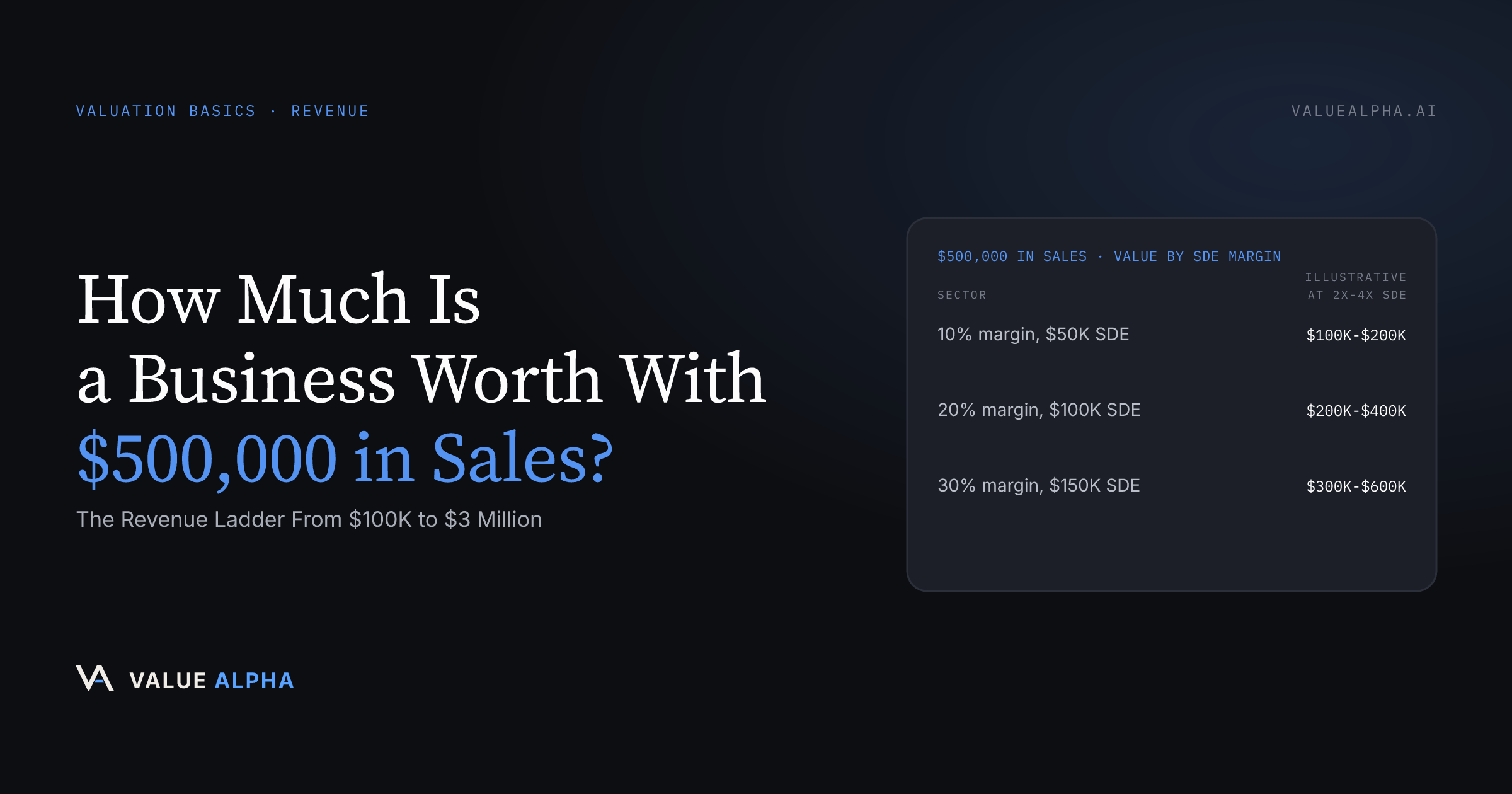
Revenue alone does not set a price. Buyers pay a multiple of earnings, so a business with $500,000 in sales is worth its seller's discretionary earnings times roughly 2x to 4x, the range owner-operated businesses typically transact in. Illustrative: at a 15% SDE margin that is $75,000 of SDE and a value of $150,000 to $300,000; at a 30% margin it is $150,000 of SDE and $300,000 to $600,000. Convert sales to normalized earnings through your margin first, then apply the sector multiple.
Seller's discretionary earnings (SDE) is pre-tax profit with one owner's salary, perks, and genuinely non-recurring costs added back: the total cash an owner-operator takes out of the business in a year. It is the metric almost every Main Street transaction is priced on, and the SDE formula sets out how to calculate it line by line.
How much is a business worth based on sales?
In two steps, and the first one is the one owners skip.
- Convert sales to SDE using your normalized margin. A business doing $500,000 at a 30% SDE margin is a different company from one doing $500,000 at 10%, and they are worth roughly three times different amounts. Margin, not revenue, is where the value lives.
- Apply the multiple that fits the earnings size. Owner-operated businesses commonly transact at roughly 2x to 4x SDE. The deal-size table in business valuation multiples by industry narrows that band by earnings: under $250,000 of SDE the practical range is tighter and lower than the headline 2x to 4x, because the buyer pool is individuals financing the purchase out of the cash flow they are buying.
Every table below runs that calculation at three margin levels. All ranges are illustrative, built from the 2x to 4x owner-operated band, not quoted transactions. The sector, the customer mix, and how much of the business walks out with the owner decide the position inside the range.
How much is a business worth with $100,000 in sales?
At this level the transaction is usually an asset sale rather than a business sale: the buyer is purchasing equipment, a client list, and a name.
| SDE margin | SDE | Value at 2x to 4x |
|---|---|---|
| 10% | $10,000 | $20,000 to $40,000 |
| 20% | $20,000 | $40,000 to $80,000 |
| 30% | $30,000 | $60,000 to $120,000 |
Below roughly $50,000 of SDE, most brokers will not list the business and most banks will not finance it. Value often reverts to the asset floor, meaning the resale value of the equipment and inventory, whichever is higher.
How much is a business worth with $200K in sales?
| SDE margin | SDE | Value at 2x to 4x |
|---|---|---|
| 10% | $20,000 | $40,000 to $80,000 |
| 20% | $40,000 | $80,000 to $160,000 |
| 30% | $60,000 | $120,000 to $240,000 |
The honest test at this rung: after a buyer pays themselves for the hours the business actually requires, is anything left? If the $60,000 of SDE is really a part-time wage, a buyer will price it as a job, not as an investment.
How much is a business worth with 300k revenue?
| SDE margin | SDE | Value at 2x to 4x |
|---|---|---|
| 10% | $30,000 | $60,000 to $120,000 |
| 20% | $60,000 | $120,000 to $240,000 |
| 30% | $90,000 | $180,000 to $360,000 |
This is where recurring revenue starts to visibly change the answer. A $300,000 service business with contracted maintenance agreements prices near the top of its band; the same revenue earned one job at a time prices near the bottom.
How much is a business worth with $500,000 in sales?
| SDE margin | SDE | Value at 2x to 4x |
|---|---|---|
| 10% | $50,000 | $100,000 to $200,000 |
| 20% | $100,000 | $200,000 to $400,000 |
| 30% | $150,000 | $300,000 to $600,000 |
The spread across those three rows, $100,000 to $600,000 on identical sales, is the entire argument against revenue-based rules of thumb. Note also that the 30% row is the first rung where SBA 7(a) financing becomes routinely available, which widens the buyer pool and supports the upper half of the range.
How much is a business worth with $1,000,000 in sales?
| SDE margin | SDE | Value at 2x to 4x |
|---|---|---|
| 10% | $100,000 | $200,000 to $400,000 |
| 20% | $200,000 | $400,000 to $800,000 |
| 30% | $300,000 | $600,000 to $1,200,000 |
A million dollars in sales is the number owners most often quote at parties, and it resolves to anything from $200,000 to $1.2M. At $300,000 of SDE the business is squarely in ETA and search-fund territory, and buyers at that level will test the add-backs closely, because every dollar of unsupported adjustment costs them two to four dollars of price.
How much is a business worth with $2 million in sales?
| SDE margin | SDE | Value at 2x to 4x |
|---|---|---|
| 10% | $200,000 | $400,000 to $800,000 |
| 20% | $400,000 | $800,000 to $1,600,000 |
| 30% | $600,000 | $1,200,000 to $2,400,000 |
Around this size the question of who runs the business starts to move the multiple more than the sector does. If a general manager already handles operations, a buyer can pay toward the top of the band; if the owner is the estimator, the salesperson, and the licence holder, the discount is real and large.
How much is a business worth with $3 million in sales?
| SDE margin | SDE | Value at 2x to 4x |
|---|---|---|
| 10% | $300,000 | $600,000 to $1,200,000 |
| 20% | $600,000 | $1,200,000 to $2,400,000 |
| 30% | $900,000 | $1,800,000 to $3,600,000 |
The 30% row is close to the metric switch. Once earnings pass roughly $1M, and once salaried management rather than the owner runs the business, buyers price on EBITDA at roughly 4x to 9x instead of SDE at 2x to 4x. Applying an EBITDA multiple to an SDE figure is the most expensive arithmetic error in small-business valuation, and SDE vs EBITDA covers exactly where the line sits.
When a revenue multiple is used instead
Revenue multiples are a cross-check, not a method, and they only hold where margins cluster tightly enough that revenue is a reliable proxy for earnings. Four sectors qualify in practice:
- SaaS, where gross margins sit in a narrow high band and annual recurring revenue is the unit buyers actually underwrite.
- Insurance brokerage, priced on annual commissions and fees because renewal economics are broadly similar across books.
- Staffing and recruiting, where gross margin per placement varies far less than headline revenue.
- Dental practices, cross-checked against annual collections, a convention that predates most valuation software.
The revenue multiple ranges for these sectors live in the revenue multiples section of the industry multiples guide and are not repeated here. Outside those cases, a revenue multiple is a shortcut that hides the only variable that matters: whether the sales convert to cash.
Primary sources worth knowing when you check any of these numbers against the market: IBBA Market Pulse for quarterly Main Street and lower-middle-market transaction data, DealStats and BVR for closed private-transaction multiples, and IRS Revenue Ruling 59-60 for the factors a defensible valuation is expected to weigh. ValueAlpha runs the same logic against 9,000+ completed transactions and returns a VA Range, bear, base, and bull, rather than a single figure. Run your own numbers in the business valuation calculator and the margin step is done for you.
Frequently Asked Questions
How many times revenue is a business worth?
For most owner-operated businesses, between roughly 0.2x and 1.2x revenue, but that is an output rather than an input: it is simply the SDE margin multiplied by the SDE multiple. A 10% margin business at 2x SDE lands at 0.2x revenue; a 30% margin business at 4x SDE lands at 1.2x. Quoting the revenue multiple without knowing the margin behind it tells you nothing about the business.
Is a business with $500,000 in revenue worth $500,000?
Only by coincidence, and it requires a 1.0x revenue multiple, which implies something like a 25% to 30% SDE margin paired with a top-of-range multiple. Most $500,000 businesses land well below their own sales figure, commonly between $150,000 and $400,000.
Does higher revenue always mean a higher valuation?
No. Revenue growth bought with discounting, paid acquisition, or a single large customer can lower value, because it compresses margin and concentrates risk at the same time. A business that grew from $2M to $3M while its SDE margin fell from 20% to 10% is worth less after the growth than before it.
Key Takeaways
- Revenue is an input, not an answer. Normalize earnings first, then apply a multiple.
- Owner-operated businesses commonly transact at roughly 2x to 4x SDE; the same sales figure can support a threefold spread in value depending on margin.
- $500,000 in sales typically values at $150,000 to $400,000, and reaches $600,000 only at a 30% margin with a top-of-range multiple.
- Once earnings pass roughly $1M and management runs the business, buyers switch to EBITDA at roughly 4x to 9x.
- Revenue multiples are legitimate only where margins cluster: SaaS, insurance brokerage, staffing, dental.
ValueAlpha Team
Finance & AI Experts
MBA-trained valuation professionals and engineers building the future of private company valuation. We combine institutional finance methodologies with AI to make defensible valuations accessible to every business owner.
LinkedInRelated Articles
valuationguidebusiness owners
How Much Is My Business Worth? A Complete Guide
Learn exactly how to determine your business valuation using the three main approaches: income, market, and asset-based methods. Avoid common mistakes and understand why valuation ranges matter more than a single number.
February 16, 2026 · 11 min
SDEseller's discretionary earningsadd-backssmall business ownersbusiness valuationM&A advisory
The SDE Formula: How to Calculate Seller's Discretionary Earnings (2026)
The SDE formula explained step by step: how to calculate Seller's Discretionary Earnings, exactly which add-backs to include, a worked example, and how SDE sets a business's value.
July 22, 2026 · 9 min
valuation basicsSDEEBITDAsmall business
SDE vs EBITDA: Which Metric Matters for Your Business Valuation?
Understanding the difference between Seller's Discretionary Earnings and EBITDA - and why choosing the wrong one can cost you millions in a sale.
March 3, 2026 · 5 min
From Our LinkedIn
Follow us for valuation insights and industry analysis
Value Alpha
Valuing a private company should not be a black box. Upload the financials and get a defensible bear, base and bull range with every figure traced back to the document it came from. Multiple engines. Sector-specific.
Value Alpha
Not all businesses are valued the same way. A biotech with a drug pipeline needs Pipeline SOTP analysis. A manufacturing company needs asset-based valuation. An IT services firm needs comparable companies. Value Alpha calibrates engines by industry.
Value Alpha
Scenario analysis: change the debt paydown, the growth rate or the margin, and watch the range move. Every engine reruns and the drivers are shown, so you can see which assumption is carrying the value.