

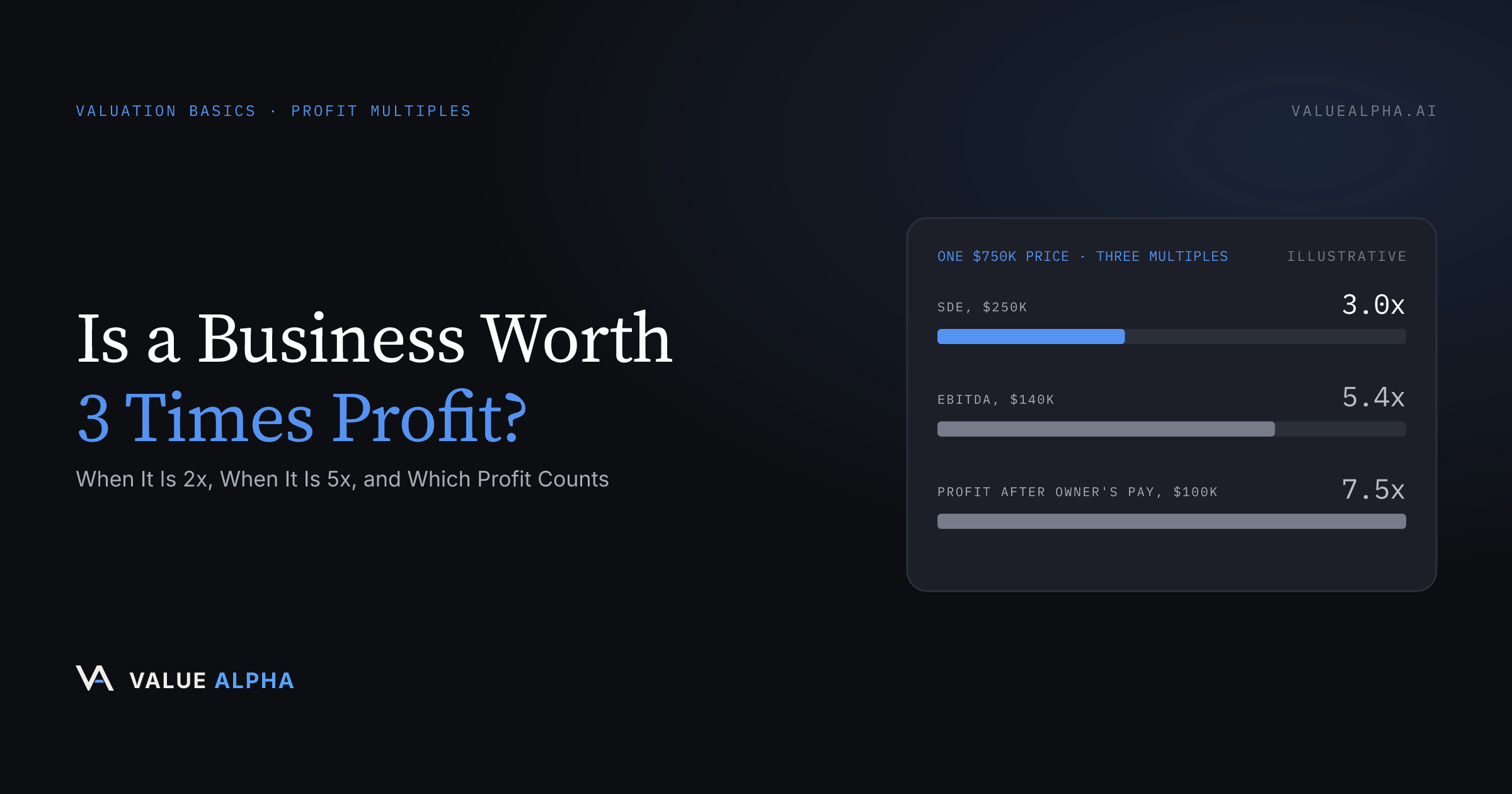
For most owner-operated businesses, yes: 3x sits in the middle of the 2x to 4x range of seller's discretionary earnings that Main Street businesses typically transact in, so "three times profit" is a reasonable anchor, not a rule. 5x is a top-of-range outcome for an owner-operated company and a bottom-of-range outcome for a management-run one, because once earnings pass roughly $1M, buyers switch to EBITDA multiples of 4x to 9x. The profit that gets multiplied is SDE, meaning pre-tax profit plus the owner's salary, perks and one-time costs, not net income after the owner has been paid.
A profit multiple is the price divided by one year of normalized earnings: "three times profit" means paying for three years of the cash a new owner can take out. When an owner tells me their company is worth three times profit, my first question is always the same: which profit?
Is a business worth 3 times profit?
Often, for a mechanical reason. An individual buyer borrows most of the price, then pays themselves and the lender out of the same SDE, and around 3x that arithmetic works for a typical owner-operated business. The 2x to 4x band itself comes from completed deals: the quarterly IBBA Market Pulse broker survey reports them by size band, and DealStats records closed private sales with their financials. But 3x rests on four assumptions, and each one can fail:
| Assumption | What 3x takes for granted | What changes when it fails |
|---|---|---|
| Metric | The profit is SDE, with one owner's pay, perks and one-time costs added back | Illustrative: $100,000 of profit after the owner's pay is $250,000 of SDE; 3x the wrong figure gives $300,000, not $750,000 |
| Size band | Earnings sit where owner-operated businesses trade at 2x to 4x SDE | Illustrative: at $120,000 of SDE, 3x is above what the smallest businesses fetch; at $1.5M of EBITDA with a management team, it is more than a turn below the usual band |
| Transferability | Customers, staff and know-how stay when the owner leaves | Illustrative: owner-held relationships, or one customer above 25% of revenue, commonly cost half a turn to a turn and a half |
| Evidence behind the add-backs | Every add-back is documented and survives a quality of earnings review | Illustrative: $40,000 of rejected add-backs takes $120,000 off a 3x price |
How many times profit is a business worth?
Roughly 2x to 4x SDE for an owner-operated business, and 4x to 9x EBITDA once salaried management runs it and earnings pass about $1M.
Size sets the band. The smallest businesses trade below 3x because their buyers finance the deal out of the cash flow they are buying, and the multiple steps up as earnings grow. The deal-size table in the multiples guide gives the band for each earnings level.
The business sets the position. Contracted revenue, a team that runs the company without you, and clean books push toward the top. Customer concentration, owner dependence and declining revenue push toward the bottom.
How many times earnings is a business worth?
It depends on which earnings. Private-company buyers price on earnings before interest and tax, because they bring their own financing: SDE for owner-operated businesses, EBITDA for management-run ones, rarely the P/E ratios quoted for public stocks.
Take an illustrative business with $100,000 of P&L profit after paying its owner a $95,000 salary. Add back the salary, $15,000 of perks, $20,000 of depreciation, $10,000 of interest and a $10,000 one-time legal bill, and SDE is $250,000. Deduct a market-rate $110,000 manager in place of the owner, and EBITDA is $140,000. Now price it at $750,000:
| Earnings measure (illustrative) | Amount | Multiple implied by a $750,000 price |
|---|---|---|
| Profit after the owner's salary | $100,000 | 7.5x |
| EBITDA, after a market-rate manager | $140,000 | 5.4x |
| SDE | $250,000 | 3.0x |
One price, three multiples, all of them correct. The SDE formula covers each add-back line by line.
Is a business worth 5 times profit?
Sometimes, depending on which profit. For an owner-operated business valued on SDE, 5x is a top-of-range outcome, found where revenue is contracted and buyers compete for it: pest control routes, IT managed services firms with recurring monthly contracts, veterinary practices courted by consolidators. For a management-run company above about $1M of EBITDA, 5x sits near the bottom of the range, because private equity funds and strategic acquirers bring institutional debt and bid against each other.
The trap is carrying one world's multiple into the other. Five times the SDE above is $1.25M, more than most individual buyers could finance; five times its EBITDA is $700,000, less than the 3x SDE price. Same business, same "five times profit", a $550,000 difference.
How do owners misapply the 3x rule?
In two ways: they multiply the wrong profit figure, or they apply a multiple built for a company of a different size. A buyer's quality of earnings (QoE) review treats the two very differently.
The wrong profit figure. Some owners multiply the profit on their tax return, which was built to be small, and undervalue the business by half or more. Others multiply a "profit" stuffed with every add-back they can imagine. The QoE rebuilds SDE from tax returns and bank statements and strips anything without a paper trail, and at 3x each rejected dollar costs three. What it will not do is find the salary you forgot to add back: diligence is paid to catch what a seller overstated, not what they left out. Documenting the add-backs that survive is your job.
The wrong size band. An owner with $150,000 of SDE reads that companies sell for six times EBITDA; a founder with a management team and $2M of EBITDA accepts three times profit because that is the rule of thumb. The QoE rescues neither, because the multiple is agreed in the letter of intent and diligence moves only the earnings underneath it, as quality of earnings vs valuation shows. It can, however, move a business across the line. A company showing $1.1M of "EBITDA" with the owner's salary still added back drops to $950,000 once the QoE deducts a $150,000 market-rate general manager, and a different buyer pool prices it at a different multiple. That is the valuation gap reopening after the business is off the market.
How much do you typically sell a business for?
Typically two to four times SDE, with many Main Street deals landing between 2x and 3x: $500,000 to $1,000,000 for the illustrative business above, with $750,000 as the 3x anchor. The amount you bank is smaller than the headline. Closed deals commonly settle below the asking price; the price is enterprise value, so debt is repaid from it and a working capital peg is settled at closing; and seller notes, escrows and earnouts defer part of it.
Check any figure against completed transactions, never listings. ValueAlpha prices against 9,000+ completed transactions and returns a VA Range, bear, base and bull with a VARI reliability score, rather than a single multiple; the business valuation calculator is a quick, limited first pass.
Frequently Asked Questions
Is three times profit before or after the owner's salary?
Before. SDE adds back one working owner's salary, benefits and perks, because the buyer will pay themselves out of the same pool. With two working owners, only one salary is added back; the second stays in as a cost, at what hiring for that role would cost.
Does a 3x multiple include inventory and real estate?
Usually not. The multiple normally covers the operating business, meaning goodwill and the equipment needed to run it. In many Main Street deals inventory is added at cost on top, and real estate is valued separately, often kept by the seller and leased to the buyer. Conventions vary by sector and by source, so check what a quoted multiple includes.
Can a business sell for less than two times profit?
Yes. Very small businesses, those that depend on the owner's labor or license, and those with declining revenue or one dominant customer commonly trade below 2x SDE. Below roughly $50,000 of SDE, value often falls back to the resale value of the equipment and inventory.
Key Takeaways
- 3x is an anchor, not a rule: the middle of the 2x to 4x SDE band for owner-operated businesses.
- The profit that counts is SDE, not the profit left after you have paid yourself.
- 5x is the top of the range for an owner-operated business and the bottom for a management-run one, priced on EBITDA at roughly 4x to 9x.
- Diligence moves the earnings, not the multiple: at 3x, every rejected dollar of add-backs costs three dollars of price.
- The price is not the proceeds: debt, the working capital peg and deferred payments sit between them.

Tomasz Felpel
Founder & CEO, Value Alpha
Columbia Business School MBA and founder of Value Alpha. Former Global Business Development Manager at IFF, where he contributed to a multibillion-dollar Fortune 500 merger. VP of Startup Lab at Columbia Entrepreneurship Organization.
LinkedInRelated Articles
SDEseller's discretionary earningsadd-backssmall business ownersbusiness valuationM&A advisory
The SDE Formula: How to Calculate Seller's Discretionary Earnings (2026)
The SDE formula explained step by step: how to calculate Seller's Discretionary Earnings, exactly which add-backs to include, a worked example, and how SDE sets a business's value.
July 22, 2026 · 9 min
quality of earningsdue diligenceETAsearch fundsM&A advisory
Quality of Earnings vs. Valuation: What Changes Between the LOI and Closing
A valuation sets the multiple; a Quality of Earnings (QoE) report tests the earnings underneath it. Here's what QoE actually examines, the adjustments that re-price deals, and how both sides prepare.
July 27, 2026 · 8 min
revenue multiplesSDEvaluation basicssmall business ownerssellers
How Much Is a Business Worth With $500,000 in Sales? The Revenue Ladder From $100K to $3 Million
Revenue does not set a price, earnings do. See what businesses at $100K, $200K, $300K, $500K, $1M, $2M and $3M in sales are worth at 10%, 20% and 30% margins.
September 18, 2026 · 9 min
From Our LinkedIn
Follow us for valuation insights and industry analysis
Value Alpha
Valuing a private company should not be a black box. Upload the financials and get a defensible bear, base and bull range with every figure traced back to the document it came from. Multiple engines. Sector-specific.
Value Alpha
Not all businesses are valued the same way. A biotech with a drug pipeline needs Pipeline SOTP analysis. A manufacturing company needs asset-based valuation. An IT services firm needs comparable companies. Value Alpha calibrates engines by industry.
Value Alpha
Scenario analysis: change the debt paydown, the growth rate or the margin, and watch the range move. Every engine reruns and the drivers are shown, so you can see which assumption is carrying the value.