

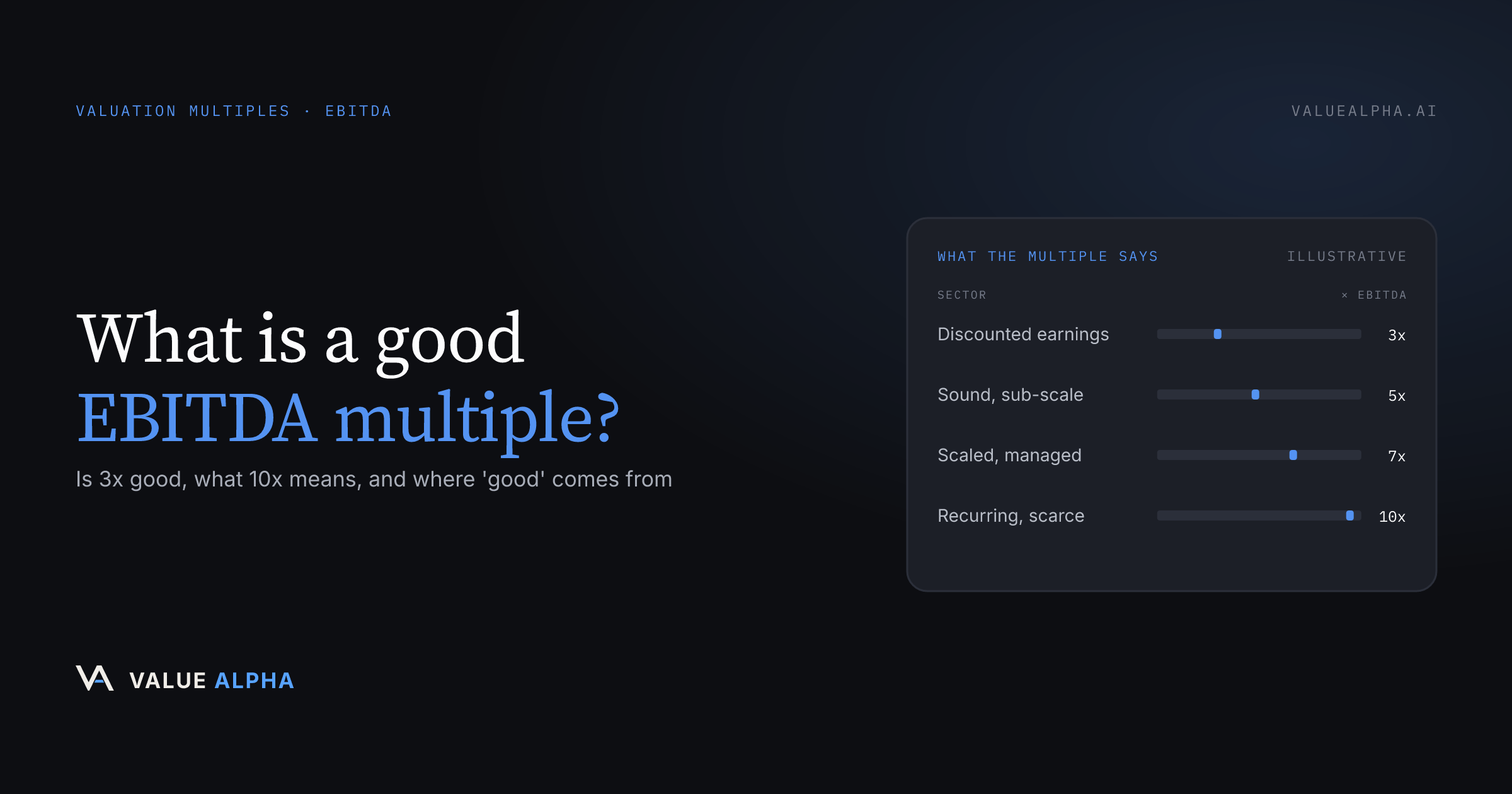
An EBITDA multiple is enterprise value divided by EBITDA, and whether a multiple is good depends on the size of the business: lower-middle-market companies with $1M to $5M of EBITDA commonly transact at 4.5x to 7x, rising toward 9x and above once EBITDA passes $10M. 3x EBITDA is low for a management-run company and usually signals customer concentration, declining revenue or owner dependence; 10x means the buyer is paying ten years of current earnings, a premium reserved for recurring-revenue, high-growth or strategically scarce businesses.
EBITDA is earnings before interest, taxes, depreciation and amortization, normalized for owner perks and one-time items; a $9M price for $1.5M of EBITDA is a 6x multiple.
What is a good EBITDA multiple?
One at or above the band for the company's size, from a buyer who can actually close. The same 6x is strong at $1.5M of EBITDA and weak at $15M. Three things set the band, in this order:
- Size. Bigger companies draw more bidders and cheaper debt, so each step up in earnings adds turns; the deal-size table in the multiples guide gives the band for each level.
- Sector. Recurring, high-margin, low-capex sectors sit higher; understanding EBITDA multiples covers the main ones.
- The business itself. Contracted revenue, an owner-independent team and clean books push it up; concentration and decline push it down.
Read from the number to what it says about the business:
| Multiple | What it usually implies | Buyer type that typically pays it |
|---|---|---|
| 3x | Earnings the buyer does not trust: a dominant customer, decline, owner dependence or heavy capex | Individual and turnaround buyers, asset buyers |
| 5x | A sound, transferable company at the bottom of the lower middle market, or a larger one with a known flaw | Independent sponsors, search funds, family offices |
| 7x | Scale, management in place, diversified customers, books ready for a quality of earnings review | Lower-middle-market private equity, strategics |
| 10x | Recurring revenue, sustained growth, high margins or a position competitors cannot copy | Strategics pricing in synergies, PE in a competitive auction |
Where does a "good" multiple actually come from?
From the return the buyer needs. A multiple is roughly the inverse of the buyer's pre-tax earnings yield: 3x is a 33% yield, 5x is 20%, 10x is 10%. Buyers accept a lower yield, and pay a higher multiple, when earnings are more certain, expected to grow, or financeable with cheap debt.
So "good" comes from completed deals, not asking prices or public markets: the quarterly IBBA Market Pulse survey reports multiples by deal size, DealStats records closed private transactions with their financials, and GF Data tracks private-equity-sponsored deals above roughly $10M of enterprise value. Value Alpha prices against 9,000+ completed transactions the same way and returns a VA Range (bear, base and bull, with a VARI reliability score) instead of one multiple.
What is a good EBITDA multiple for a small business in 2026?
For a management-run company with $1M to $5M of EBITDA, 4.5x to 7x, with the top reserved for recurring revenue, a real management team and diversified customers. Below roughly $1M of earnings, buyers stop quoting EBITDA and price owner-operated businesses on SDE at about 2x to 4x, as SDE vs EBITDA explains. A 6x EBITDA headline on a $400,000 owner-operated business is a common way to overprice.
The year matters because financing sets the ceiling: most buyers borrow much of the price (SBA 7(a) loans at the small end, senior and mezzanine debt above), so higher rates lower the multiple they can pay and still cover debt service. Check the latest Market Pulse before anchoring on an older figure; the business valuation calculator is a quick, limited first pass.
Is 3x EBITDA good?
For the seller of a management-run company, usually not: 3x sits well below the lower-middle-market band and means a buyer has found a reason to discount the earnings. Typical reasons are a customer above 25% of revenue (see customer concentration), declining revenue, owner dependence, peak-cycle earnings, or capital spending that EBITDA leaves out. For a buyer, 3x is good only if the earnings last; paid for shrinking earnings, it is expensive.
Keep the metrics apart. 3x SDE is a normal price for an owner-operated business, as is a business worth 3 times profit shows. 3x EBITDA, after a market-rate manager's salary, is cheap.
What does a 10x EBITDA multiple mean?
The buyer pays $10 of enterprise value per $1 of annual EBITDA: ten years of current earnings, before tax, capex and debt service. An illustrative company with $2M of EBITDA sold at 10x is worth $20M, a 10% pre-tax yield.
Buyers pay it because they are not buying today's earnings. If that $2M grows 20% a year, year-three EBITDA is about $3.46M, and $20M is roughly 5.8x it. A strategic acquirer that can remove $1M of overlapping cost is paying about 6.7x the combined earnings. In the guide's bands for $1M to $10M of EBITDA, only software and SaaS, insurance brokerage and wealth management reach 10x.
Is 10x EBITDA good?
For most private-company sellers it is an excellent outcome, and outside those sectors it usually takes more than $10M of EBITDA or a strategic buyer with synergies. For a buyer it is good only if the growth or synergy is real; if growth stalls, the next buyer may price the company at 6x. Check the structure, too: a 10x headline with a large earnout or seller note can put less cash in your hands at closing than an 8x all-cash offer, as seller financing, earnouts and escrow shows.
What's the difference between a revenue multiple and an EBITDA multiple?
A revenue multiple divides enterprise value by sales; an EBITDA multiple divides it by operating earnings. The margin links them: revenue multiple = EBITDA multiple × EBITDA margin, so 6x EBITDA at a 15% margin is 0.9x revenue. EBITDA multiples carry the weight for profitable businesses; revenue multiples appear where margins cluster tightly, as in staffing, or where profit has not arrived, as with growth-stage SaaS priced on ARR.
"Is 10% EBITDA good?" is a different question: it asks about the margin, EBITDA divided by revenue, not the multiple. A 10% margin is healthy for a distributor and thin for a software company; margin moves the multiple only indirectly, through how durable the earnings look.
What is the Rule of 40 for EBITDA?
A software benchmark: revenue growth rate plus EBITDA margin should total at least 40%. Growing 25% at a 15% margin scores 40; growing 50% at a 10% loss also scores 40. Some investors use free cash flow margin instead. Companies above 40 tend to earn premium multiples. The rule applies to subscription software, not an HVAC contractor, and for smaller SaaS companies buyers often weight churn and net revenue retention more (see how SaaS businesses are valued).
Frequently Asked Questions
Is an EBITDA multiple the same as a P/E ratio?
No. A P/E ratio divides the equity price by net income, after interest and tax, and is quoted for public stocks. An EBITDA multiple divides enterprise value by earnings before interest, tax, depreciation and amortization. Private-company buyers prefer it because they bring their own financing.
Why do public companies trade at higher EBITDA multiples than private ones?
Size, liquidity and diversification. A listed share sells in seconds, and a public company usually has many customers and deep management; a private company carries key-person risk and takes months to sell. Applying a public sector average to a private business with $2M of EBITDA typically overstates its value by several turns.
Key Takeaways
- "Good" depends on size first: 4.5x to 7x for $1M to $5M of EBITDA, toward 9x and above past $10M.
- 3x EBITDA signals discounted earnings, while 3x SDE is a normal price for an owner-operated business.
- 10x is ten years of current earnings, justified only by recurring revenue, growth or bankable synergies.
- Revenue multiple = EBITDA multiple × margin: margin and multiple answer different questions.
- Benchmark against completed deals: IBBA Market Pulse, DealStats and GF Data, not asking prices or public comps.
Value Alpha Team
Finance & AI Experts
MBA-trained valuation professionals and engineers building the future of private company valuation. We combine institutional finance methodologies with AI to make defensible valuations accessible to every business owner.
LinkedInRelated Articles
EBITDAmultiplesindustry analysis
Understanding EBITDA Multiples by Industry
Learn what EBITDA multiples are, how they are used in business valuations, and what typical ranges look like across major industries including technology, healthcare, manufacturing, retail, and professional services.
February 16, 2026 · 5 min
valuation basicsSDEEBITDAsmall business
SDE vs EBITDA: Which Metric Matters for Your Business Valuation?
Understanding the difference between Seller's Discretionary Earnings and EBITDA - and why choosing the wrong one can cost you millions in a sale.
March 3, 2026 · 5 min
valuation multiplesSDErules of thumbsmall business ownerssellers
Is a Business Worth 3 Times Profit? When It Is 2x, When It Is 5x, and Which Profit Counts
Is a business worth 3 times profit? Often, if the profit is SDE. When 2x or 5x applies instead, which profit counts, and what diligence does to the price.
September 21, 2026 · 7 min
From Our LinkedIn
Follow us for valuation insights and industry analysis
Value Alpha
Valuing a private company should not be a black box. Upload the financials and get a defensible bear, base and bull range with every figure traced back to the document it came from. Multiple engines. Sector-specific.
Value Alpha
Not all businesses are valued the same way. A biotech with a drug pipeline needs Pipeline SOTP analysis. A manufacturing company needs asset-based valuation. An IT services firm needs comparable companies. Value Alpha calibrates engines by industry.
Value Alpha
Scenario analysis: change the debt paydown, the growth rate or the margin, and watch the range move. Every engine reruns and the drivers are shown, so you can see which assumption is carrying the value.