

What Are EBITDA Multiples?
Updated September 2026 to align with our industry multiples reference.
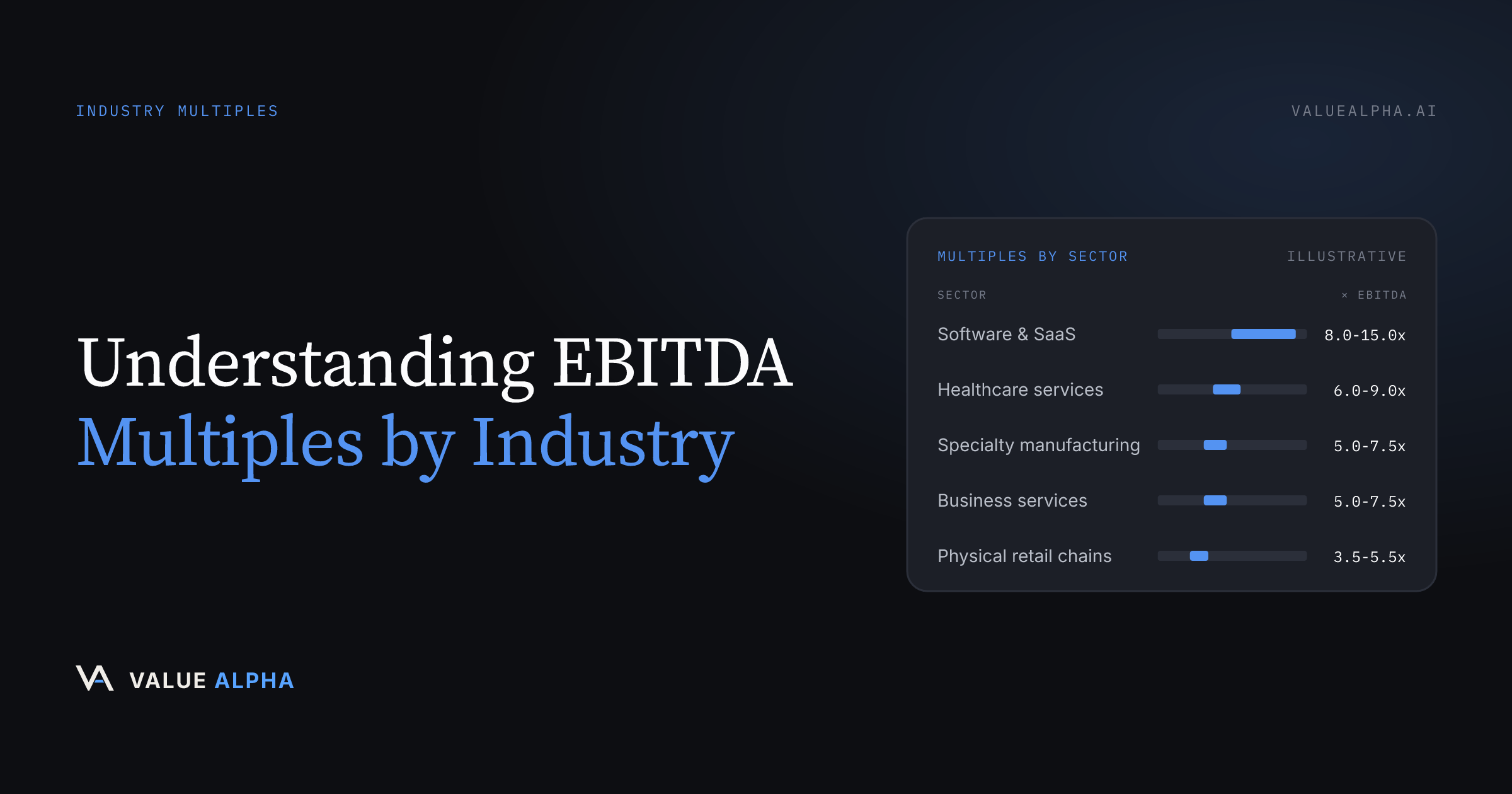
The short answer: private companies typically trade at roughly 4x to 9x EBITDA in the lower middle market, rising with size, while owner-operated businesses below about $1M of earnings are usually priced on SDE at roughly 2x to 4x instead. Sector sets the band inside that range, from physical retail chains at 3.5x to 5.5x up to software and SaaS at 8.0x to 15.0x, and growth, margins, revenue quality, and customer concentration decide where a specific business lands within its band. The sector ranges in this article follow our business valuation multiples by industry reference.
EBITDA multiples are one of the most commonly used valuation metrics in business transactions. The concept is straightforward: take a company's enterprise value and divide it by its EBITDA (earnings before interest, taxes, depreciation, and amortization) to get a ratio that represents how much buyers are willing to pay per dollar of operating earnings.
If a company generates $2 million in EBITDA and is valued at $12 million, its EBITDA multiple is 6.0x. Business valuation multiples like this provide a quick, intuitive way to benchmark a company's value against its peers and against historical transaction data.
EBITDA is the preferred earnings metric for multiples because it strips out the effects of capital structure (interest), tax jurisdiction (taxes), and accounting policy (depreciation and amortization). This makes it easier to compare companies on an apples-to-apples basis regardless of how they are financed or where they are located.
How EBITDA Multiples Are Used in Valuations
In practice, EBITDA multiples appear in two contexts. The first is comparable company analysis, where you look at the trading multiples of publicly listed companies in the same industry. The second is precedent transaction analysis, where you look at the multiples paid in actual acquisitions of similar businesses.
To estimate the value of a private company using this approach, you identify a set of appropriate comparables, determine the relevant multiple range, and apply it to the subject company's EBITDA. But selecting the right multiple is where the nuance lies. Industry is the starting point, but it is far from the only factor.
Typical EBITDA Multiple Ranges by Industry
The ranges below are the lower-middle-market bands from our business valuation multiples by industry reference, which is the authoritative table on this site: they apply to management-run companies with roughly $1M to $10M of EBITDA and clean, verifiable financials. Larger companies above $10M of EBITDA and publicly listed companies trade above these bands, which is why a public-company sector average is the wrong benchmark for a private business of this size. Below roughly $1M of earnings, buyers usually switch to SDE multiples of about 2x to 4x, so the EBITDA figures here should not be applied to an owner-operated business. Actual multiples for any specific company will also vary with growth, margins, revenue quality, and the other factors discussed later in this article.
Software and SaaS
Software and SaaS companies command the highest EBITDA multiples in the lower middle market, typically 8.0x to 15.0x. Recurring revenue, high gross margins, and low capital intensity make each dollar of EBITDA more predictable and more scalable than in almost any other sector, and an active pool of strategic and private equity acquirers competes for the businesses that prove it.
The top of the band is reserved for net revenue retention above 100%, low churn, and gross margin above 75%. Project-based technology services firms, whose revenue has to be re-won each year, are priced more like business and outsourced services, at 5.0x to 7.5x, than like subscription software.
Healthcare Services
Healthcare services businesses typically trade at 6.0x to 9.0x EBITDA once they have salaried management and multi-site scale. Regulatory barriers to entry, aging demographics driving long-term demand, and the essential nature of the services keep the band above most other sectors, while significant variation remains across sub-sectors such as physician groups, home health, behavioral health, and healthcare IT.
Payer diversification, provider retention, and multi-site scalability push a business toward the top of the range. Owner-operated clinics below the EBITDA threshold are a different market: the reference guide puts medical and specialty clinics at 2.5x to 4.5x SDE, where payer mix and provider non-competes are decisive.
Specialty Manufacturing
Specialty manufacturers typically see EBITDA multiples of 5.0x to 7.5x. Commodity producers with thin margins and heavy capital requirements sit at the bottom of the band, while manufacturers with proprietary products, sole-source positions, and aftermarket revenue command the top.
Long-term contracts, specialized certifications, and high switching costs are what push manufacturing multiples higher. The capital-intensive nature of the sector and its exposure to commodity price fluctuations are what keep the band below asset-light industries. For owner-operated shops, the guide's light manufacturing range is 2.5x to 4.0x SDE, with heavy scrutiny of add-backs and capex needs.
Retail and Consumer
Physical retail chains typically trade at 3.5x to 5.5x EBITDA, the lowest band among the sectors covered here. The lease portfolio and the degree of online exposure drive most of the variation, and structural pressure from shifting consumer behavior keeps the band moderate relative to technology and healthcare.
Consumer products and brands are priced separately, at 4.5x to 7.0x EBITDA, with brand strength, retailer concentration, and margin durability setting the position. Owner-operated e-commerce and direct-to-consumer businesses are usually valued on SDE, at roughly 2.5x to 4.0x, where channel concentration and dependence on paid acquisition cut the multiple.
Professional and Business Services
Business and outsourced services firms, including consulting, accounting, engineering, and staffing companies with salaried management, typically trade at 5.0x to 7.5x EBITDA. Contract length and switching costs drive the top of the range; media, marketing, and advertising agencies sit in a similar 5.0x to 7.0x band, with retainer share of revenue and client tenure doing the work.
The primary challenge for professional services valuations is the dependency on human capital. Firms where revenue is heavily tied to a small number of key individuals face a discount because of the risk that those individuals may leave after a transaction. Companies that have built institutional client relationships and diversified their talent base trade at the higher end, and owner-dependent practices below the EBITDA threshold are priced at roughly 2.5x to 4.0x SDE, where client retention through transition is the central question.
Factors That Move Multiples Up or Down
Industry provides a starting framework, but the multiple any specific company commands depends on a combination of company-level factors.
Size Matters
Larger companies almost universally trade at higher multiples than smaller ones. A business generating $10 million in EBITDA will typically attract a higher multiple than one generating $1 million, even if they are in the same industry with similar growth rates. This size premium reflects lower perceived risk, greater operational resilience, and the broader pool of potential acquirers for larger businesses.
Growth Rate
Companies growing revenue and EBITDA at above-market rates justifiably command higher multiples. A business growing at 25% annually is worth more per dollar of current earnings than one growing at 5%, because a larger share of its value lies in future performance.
Margin Profile
Higher EBITDA margins generally correlate with higher multiples. A company converting 30% of revenue to EBITDA is viewed as more efficient and more resilient to downturns than one operating at 10% margins, all else being equal.
Revenue Quality
Recurring and contractual revenue commands a premium over project-based or one-time revenue. Subscription models, long-term service contracts, and high customer retention rates all signal predictability, which buyers value highly and reflect in the multiples they are willing to pay.
Customer Concentration
If a significant percentage of revenue comes from one or two customers, the business carries customer concentration risk. This typically results in a lower multiple because the loss of a single client could have an outsized impact on financial performance.
Management and Operations
Businesses with strong management teams that operate independently of the owner are valued more highly than those that are heavily owner-dependent. A well-documented, scalable operation signals lower transition risk and attracts a premium.
Frequently Asked Questions
Two short answers before the detailed questions. A good EBITDA multiple for a small business in 2026 is 4.5x to 7.0x for a management-run company with $1M to $5M of EBITDA, and roughly 2x to 4x SDE below about $1M of earnings. A 10x EBITDA multiple means the buyer is paying $10 of enterprise value for every $1 of annual EBITDA, a level that, in the reference bands for $1M to $10M of EBITDA, only software and SaaS (8.0x to 15.0x), insurance brokerage (8.0x to 12.0x) and wealth management (7.0x to 11.0x) reach; the full answers by size, sector and buyer type are in the business valuation multiples by industry reference.
How do I calculate an EBITDA multiple?
Divide enterprise value by normalized EBITDA. Enterprise value is the price of the operating business before debt and cash; normalized EBITDA is earnings before interest, taxes, depreciation, and amortization after removing owner perks, one-time items, and non-operating expenses. In the illustrative example above, a company valued at $12 million with $2 million of EBITDA trades at 6.0x. Two checks matter more than the arithmetic: make sure the earnings figure is EBITDA rather than SDE, and remember that the result is enterprise value, so the seller's proceeds are that figure less interest-bearing debt plus excess cash, subject to the working capital peg.
What determines the EBITDA multiple?
Size first, sector second, and the specific business third. Larger companies attract more bidders and cheaper debt and carry less key-person risk, which is why the same business earns a higher multiple at $5M of EBITDA than at $1M. Sector sets the band, from physical retail chains at 3.5x to 5.5x to software at 8.0x to 15.0x. Inside the band, recurring or contracted revenue above 50% of sales typically adds 0.5x to 1.5x, a management team that runs the business without the owner adds 0.5x to 1.0x, and a largest customer above 25% of revenue typically subtracts 0.5x to 1.5x. Growth, margins, and the quality of the financials move the number the rest of the way.
Using Multiples Wisely
EBITDA multiples are a powerful benchmarking tool, but they work best when used as part of a broader valuation framework. A multiple gives you a quick indication of relative value, but it does not tell you why a company trades where it does. Combining multiple-based analysis with a discounted cash flow model and a careful assessment of company-specific factors produces a far more complete and reliable valuation.
ValueAlpha provides industry-specific multiples alongside DCF analysis and comparable transaction data, giving you a comprehensive view of value rather than a single data point. The goal is never to rely on one number but to understand the range and the factors that determine where within that range a specific business falls.
When someone tells you a business is worth a certain multiple of EBITDA, the right response is always: compared to what, and why? Answering those questions is what separates a useful valuation from a number on a napkin.
ValueAlpha Team
Finance & AI Experts
MBA-trained valuation professionals and engineers building the future of private company valuation. We combine institutional finance methodologies with AI to make defensible valuations accessible to every business owner.
LinkedInRelated Articles
DCFvaluation methodologyfinance
DCF Analysis Explained for Private Companies
A clear, practical guide to discounted cash flow analysis for private companies. Learn the five key steps, how to estimate WACC without public market data, terminal value approaches, and common pitfalls to avoid.
February 16, 2026 · 6 min
valuation basicsSDEEBITDAsmall business
SDE vs EBITDA: Which Metric Matters for Your Business Valuation?
Understanding the difference between Seller's Discretionary Earnings and EBITDA - and why choosing the wrong one can cost you millions in a sale.
March 3, 2026 · 5 min
From Our LinkedIn
Follow us for valuation insights and industry analysis
Value Alpha
Valuing a private company should not be a black box. Upload the financials and get a defensible bear, base and bull range with every figure traced back to the document it came from. Multiple engines. Sector-specific.
Value Alpha
Not all businesses are valued the same way. A biotech with a drug pipeline needs Pipeline SOTP analysis. A manufacturing company needs asset-based valuation. An IT services firm needs comparable companies. Value Alpha calibrates engines by industry.
Value Alpha
Scenario analysis: change the debt paydown, the growth rate or the margin, and watch the range move. Every engine reruns and the drivers are shown, so you can see which assumption is carrying the value.