

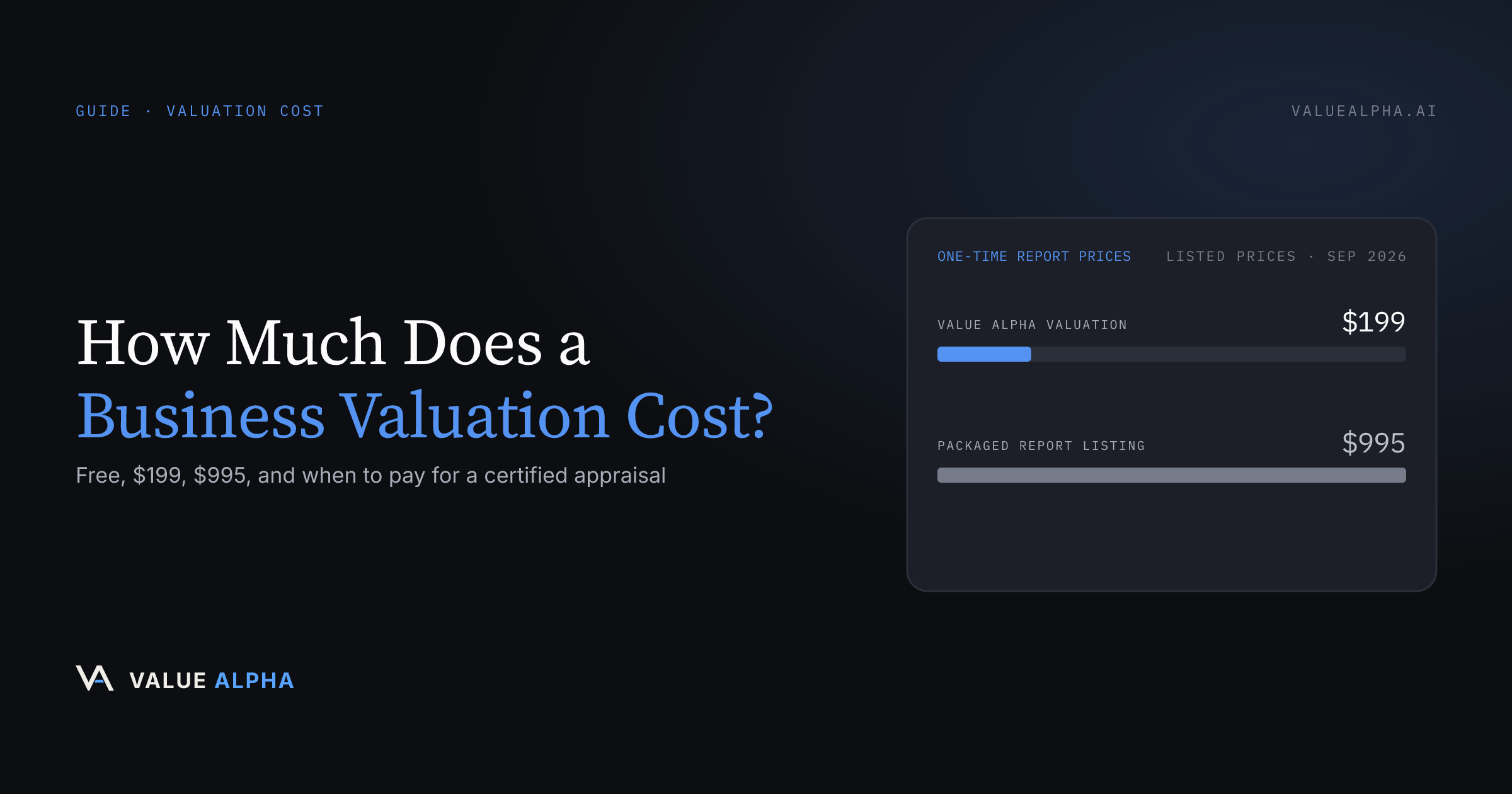
A business valuation costs anywhere from free, for a single-multiple calculator, to four figures for a written report, and more for a certified appraisal used in litigation, estate or IRS work. Two concrete anchors: a packaged "Business Valuation Report" is listed at $995 in Google Shopping results (USA Trade Registry, captured September 3, 2026), and a full Value Alpha valuation, 29 valuation methods including Monte Carlo, with a PDF memorandum (the Excel model is on Pro), is $199. Pay for a credentialed appraisal only when a court, the IRS or a lender's policy requires one.
The cost of a business valuation is the fee for producing an estimate or opinion of what a company is worth, and it is set less by the size of the company than by who will rely on the number: you, a buyer, a lender, the IRS or a judge. The more easily someone else can challenge the number, the more standards, documentation and professional liability the fee has to cover.
This guide lists every option with its price, separates the published prices from the ones quoted per engagement, and shows when each one is the right purchase.
How much does a business valuation report cost?
A business valuation report costs nothing if all you need is a number on a screen, $199 for a multi-method PDF memorandum from Value Alpha, $995 for the packaged report product listed in Google Shopping, and a per-engagement fee for anything signed by a credentialed appraiser. Only the first three are published prices. Professional firms quote each engagement separately, so any single "typical fee" for a certified appraisal that does not name its source is a guess.
| Option | Price | What you get | Turnaround | When it is the right choice |
|---|---|---|---|---|
| Free calculator | Free | One estimated range from a few inputs, no written report | Seconds | Curiosity, or a first check before you talk to anyone |
| Online multi-method valuation (Value Alpha) | $199 one-time | 29 valuation methods, a VA Range (bear, base, bull) with a VARI reliability score, PDF memorandum; Excel model on Pro | Under 10 minutes | Preparing to sell, pricing an LOI, testing a broker's number |
| Packaged report listed online | $995 (USA Trade Registry, Google Shopping, captured 2026-09-03) | A written "Business Valuation Report"; methods and data are set by the seller, so read the listing | Set by the seller | You want a written report and have checked what it covers |
| CPA or valuation firm | Quoted per engagement | A calculated value or a scoped valuation report under the firm's professional standards | Weeks, set in the engagement letter | Partner planning, a signed second opinion, internal decisions |
| Credentialed appraisal (ASA, ABV, CVA) | Quoted per engagement | A conclusion of value under USPAP or AICPA standards, built to be defended | Weeks, depending on how fast documents arrive | Litigation, divorce, estate and gift tax, ESOPs, charitable gifts |
| SBA-required appraisal | Quoted per engagement; see the SBA guide's cost section | An independent going-concern valuation ordered by the lender | Set by the lender's appraiser | A 7(a) change of ownership where the intangible portion exceeds $250,000 or the parties are related |
| Quality of earnings (QoE) | Quoted per engagement; see QoE vs valuation | Restated EBITDA or SDE after testing add-backs; not a valuation | From LOI signing to the diligence deadline | Buyer diligence after the LOI, or a seller's preparation before a sale |
Two things in the table are easy to miss. First, the free and $199 options do not carry a credential, so they cannot stand in where a regulator, lender or court requires one. Second, the QoE row is not a valuation at all: it changes the earnings number a multiple is applied to, which is why it sits after the LOI rather than before it.
How much should I pay for a business valuation?
Pay for the level of reliance you need, and no more. The useful question is not "how much does a good valuation cost?" but "who could challenge this number, and what would they demand to see?" An owner deciding whether to sell needs a defensible range and the reasoning behind it; a judge in a shareholder dispute needs a credentialed expert who can survive cross-examination. Those are different products at different prices.
| Situation | Who relies on the number | What to buy |
|---|---|---|
| Curious what the business is worth | You | A free calculator |
| Deciding whether to sell, or setting an asking range | You, then buyers and brokers | A multi-method valuation before anyone anchors the price |
| A searcher screening targets before an LOI | You and your investors | One multi-method valuation per serious target; keep QoE spend for after the LOI |
| SBA 7(a) acquisition | The lender and the SBA | The lender orders the independent appraisal; screen the price first |
| Partner buyout or shareholder dispute | The other party, possibly a court | A credentialed appraisal, scoped to the buy-sell agreement |
| Divorce | A court | A credentialed appraisal; often each side retains one |
| Estate or gift tax filing | The IRS | A qualified appraisal by a qualified appraiser |
| Raising capital or an investment committee | Investors | A multi-method memorandum; add a credentialed report only if the documents require it |
A simple rule: spend in proportion to the cost of being wrong and to the strength of whoever can push back. A search-fund buyer looking at ten targets should not buy ten appraisals. They should screen all ten cheaply, sign one LOI, and spend on diligence for that one. The LOI range itself is a pricing exercise, covered in how to set a valuation range in an LOI.
How much does a small business valuation cost?
For an owner-operated business the menu is the same: free for a calculator, $199 for a multi-method valuation, and a quote per engagement for a credentialed appraisal. Fees for professional work do rise with size, but complexity moves them more. A $2 million business with three entities, a related-party lease and undocumented add-backs can take more work than a larger company with one entity and reviewed statements.
What changes for small businesses is the earnings measure. Most owner-operated companies are priced on seller's discretionary earnings (SDE), which adds back one owner's salary and perks, and testing those add-backs is where most of the work sits. Clean, evidenced add-backs make every option cheaper and more reliable; see add-backs explained.
Three practical points for small business owners:
- A broker's free opinion of value has a cost of its own. It is often offered without charge as part of a pitch to win the listing, and the broker is paid when the business sells. Treat it as a market read and check it against an independent range.
- Sector ranges are a starting point, not a valuation. Industry pages such as HVAC and plumbing or dental practices, and the multiples by industry reference, show where multiples usually land; your own earnings quality decides where you sit inside the range.
- "Near me" matters less than sector experience. Transaction databases and standards are national. Local knowledge matters most when testimony in a particular court is likely or real estate drives the value.
Cost of professional business valuation services
Professional valuation firms, CPA firms with valuation practices and independent appraisers price each engagement separately, usually as a fixed fee for a defined scope or as hourly billing, with expert testimony commonly billed on top. No neutral body publishes a fee schedule, so the only reliable figure is a written quote for a written scope.
What sets that scope is the standard the work follows and the type of report:
| Engagement type | Standard it follows | Output | Relative cost (typical) |
|---|---|---|---|
| Calculation engagement | AICPA VS Section 100 | A calculated value using procedures agreed with the client | Lower |
| Valuation engagement, summary report | AICPA VS Section 100 or USPAP Standards 9 and 10 | A conclusion of value with condensed reasoning | Middle |
| Valuation engagement, detailed report | AICPA VS Section 100 or USPAP Standards 9 and 10 | A conclusion of value with full reasoning, data and exhibits | Higher |
| Tax appraisal | IRS Revenue Ruling 59-60 and IRS appraisal requirements | A fair market value conclusion that can be filed with a return | Higher |
| Litigation engagement | Court rules on expert evidence, such as Federal Rule of Evidence 702 | A report, rebuttal work and testimony | Highest |
The credentials you will see on these reports are the ASA (American Society of Appraisers), the ABV (AICPA) and the CVA (NACVA). A "certified" business appraisal is not a single legal category. It means the report was prepared by someone holding a recognized credential, under a recognized standard, and independent of the transaction. When you compare quotes, ask each firm the same four questions: which professional standard, which report type, which standard of value (fair market value, fair value or investment value), and whether testimony is included.
How much does a typical business valuation cost through online services?
Online valuation services fall into four groups, and their prices are the easiest in the market to compare because most are published.
| Online service type | Pricing model | Methods | Output | Main limit |
|---|---|---|---|---|
| Free calculator | Free | Usually one multiple | A range on screen | No written report, little visible reasoning |
| Advisor platform | Subscription, built for firms that value many businesses (example comparison) | Varies by platform | Branded reports | Pays off at volume, not for one sale |
| Packaged report product | $995 one-time (USA Trade Registry listing, captured 2026-09-03) | Set by the seller | A written report | Check the data and methods before buying |
| Value Alpha | $199 one-time; Excel model on Pro | 29 valuation methods, including DCF, comparable companies, precedent transactions and Monte Carlo | PDF memorandum with a VA Range and a VARI reliability score | Not a credentialed appraisal |
Before paying any online service, check four things: whether it prices against completed transactions rather than asking prices on listings, whether every assumption is visible, whether the output is a document you could hand to a buyer or lender, and whether it says plainly what it is not. The business valuation calculator is a quick, limited first pass; Value Alpha runs the full set of methods for $199 and returns a PDF memorandum, which you can preview in the sample report.
When do you need to pay for a certified appraisal?
Pay for a credentialed appraiser when the number will be filed, litigated or lent against under rules that call for one. The common triggers:
- Courts. Shareholder disputes, divorce, damages and dissenting-shareholder cases need an expert whose report and testimony meet the court's admissibility standard.
- The IRS. Estate and gift tax returns that value a closely held business follow Revenue Ruling 59-60, and charitable gifts of business interests above IRS thresholds need a qualified appraisal by a qualified appraiser.
- Lenders. Under SBA SOP 50 10, a 7(a) change-of-ownership loan needs an independent valuation from a qualified source when the intangible portion financed exceeds $250,000 or buyer and seller are related, and a bank's own credit policy can add requirements. The SBA 7(a) valuation guide covers the rules and costs.
- ESOPs. Employer stock that is not readily tradable must be valued by an independent appraiser.
- Financial reporting and equity compensation. Purchase price allocations, goodwill impairment tests and 409A valuations for stock options are prepared for auditors or the IRS, and are usually bought from specialists.
Outside these triggers, a credential adds little that a transparent, multi-method valuation does not, and a pre-sale or pre-LOI decision is usually better served by having the range early than by having a signature late.
What drives the cost up?
Four drivers explain most of the spread between quotes: purpose, standards, entities and litigation. The condition of the books, valuation discounts and the deadline come close behind.
| Driver | Why it adds cost | How to keep it down |
|---|---|---|
| Purpose | A number others rely on carries professional liability and needs more support | Buy for the purpose you have now, and state it up front |
| Standards | USPAP, VS Section 100 and IRS rules each require specific procedures and disclosures | Ask whether a calculation engagement or a summary report meets your need |
| Entities | Each legal entity, location, related-party lease or holding company adds analysis and consolidation | Send an organization chart and every entity's statements on day one |
| Litigation | Rebuttal reports, depositions and trial testimony are billed on top of the report | Agree in the engagement letter how testimony is billed |
| Books | Unreconciled accounts and undocumented add-backs turn analysis time into clean-up time | Reconcile, and document each add-back with evidence |
| Discounts | Valuing a minority stake for gift tax adds lack-of-control and lack-of-marketability analysis | Confirm early whether you are valuing 100% or a partial interest |
| Deadline | A rushed timeline reorders the firm's work | Start before the filing, LOI or court date is close |
What you are paying for
Whatever the price, a valuation is a bundle of three things: data access, methods run and an audit trail. Comparing options on those three tells you more than comparing page counts.
Data access. Market multiples are only as good as the transactions behind them. Professional firms license databases such as DealStats (formerly Pratt's Stats, from Business Valuation Resources) and read surveys such as the IBBA Market Pulse; a free calculator typically applies one published multiple. Value Alpha prices against 11,000+ comparable companies and 9,000+ completed transactions, mapped across 1,000+ NAICS codes and 43 industries supported, and counts completed deals rather than asking prices.
Methods run. A single multiple answers one question. A defensible range comes from several approaches, income (DCF), market (comparable companies and precedent transactions) and asset-based, reconciled with stated weights. Value Alpha runs 29 valuation methods, including Monte Carlo, in under 10 minutes, and shows how each one is weighted into the range.
Audit trail. The number has to survive the person who will challenge it: a buyer's QoE team, a lender's credit officer or opposing counsel. That means every input sourced, every adjustment explained and every assumption visible. The sample report walks through the Value Alpha memorandum section by section, from the VA Range on page one to the sources and analyst adjustments at the end. For the step-by-step process behind any valuation, see how to value a business.
Key Takeaways
- The price follows reliance: free for your own curiosity, $199 for a multi-method range you can defend to a buyer, and a per-engagement fee when a court, the IRS or a lender requires a credential.
- Only some prices are published: free, $199 and the $995 packaged report listing are public; credentialed appraisals, SBA appraisals and QoE reviews are quoted per engagement.
- Scope drives professional fees: purpose, standards, entities and litigation move a quote more than revenue does.
- Compare what you get, not page counts: data access, methods run and the audit trail decide whether a number survives diligence.
- Sequence the spend: price the business before a broker or buyer anchors it, then pay for QoE and any required appraisal on the one deal that reaches an LOI.
Frequently Asked Questions
How much does a business valuation cost?
Can a CPA do a business valuation?
Is a $199 online valuation enough to sell my business?
Why do quotes for professional business valuations vary so much?
Is a broker's free opinion of value the same as a valuation?
Who pays for the valuation in a business sale?
Do I need a local business appraiser?
Value Alpha Team
Finance & AI Experts
MBA-trained valuation professionals and engineers building the future of private company valuation. We combine institutional finance methodologies with AI to make defensible valuations accessible to every business owner.
LinkedInRelated Guides
How-To
How to Value a Business: A Step-by-Step Guide
A practical, step-by-step guide to valuing a business: recast the financials, pick the right methods, run DCF, comps, and the asset floor, then reconcile into a defensible range.
Reference
SBA 7(a) Business Valuation Requirements: The Complete 2026 Guide
Everything ETA buyers and sellers need to know about SBA 7(a) business valuation requirements under SOP 50 10 8 - the $250,000 independent appraisal threshold, who qualifies to perform the valuation, accepted methods, costs, and timelines.
How-To
Free Business Valuation Calculator - How It Works and How to Use It
Free business valuation calculator powered by 11,000+ SMB comps. Get a VA Range in under a minute - bear, base, and bull estimates with a confidence score. No signup, no credit card.