

Quick answer
Value a business by matching the method to how it makes money: the income approach (DCF) for what future cash flow is worth today, the market approach (comparable companies and precedent transactions) for what buyers actually pay, and the asset-based floor for the downside. Run the two or three methods that fit the business type, weight them by relevance rather than evenly, then triangulate the outputs into a single low, base, and high range instead of one number. The eight steps below walk through gathering the inputs, running each method, and documenting the assumptions so the range holds up in a real negotiation.
Summary
Valuing a business is not one calculation. It is a disciplined process: clean up the financials, run two or three valuation methods that fit the business, then reconcile the answers into a range you can defend. The single number you see on a broker's listing is the start of a negotiation, not a valuation.
This guide walks through the exact eight steps a serious owner, buyer, or advisor follows. It applies whether you are a Main Street owner planning an exit, a search-fund or SBA buyer sizing an offer, or an advisor setting expectations in a first meeting. By the end you will know which methods to run, how to run them, and how to turn the output into a defensible value range with documented assumptions.
If you want a fast directional read before you start, run the business valuation calculator to get a grounded range in seconds. Then come back and do the full work below when the number actually matters.
Step 1: Gather and normalize the financials
Every valuation is only as good as the earnings number underneath it. Before you touch a multiple or a discount rate, you have to recast the financials so they show what the business truly earns for a new owner.
Start by pulling three years of tax returns or reviewed financials plus a current year-to-date interim statement. Then recast the profit and loss to strip out distortions:
- Owner add-backs. Above-market owner salary, personal vehicles, family on payroll, personal travel, country club dues, and home office costs that will not transfer to a buyer.
- One-time items. Legal settlements, a roof replacement, a failed product launch, PPP forgiveness, or any expense that will not recur.
- Non-operating items. Rent paid to a related party that is above or below market, investment income, and assets unrelated to operations.
This produces two earnings numbers that matter:
- SDE (seller's discretionary earnings) adds back one full-time owner's total compensation. Use it for owner-operated businesses under roughly $1M to $2M in earnings, where one person runs the show.
- EBITDA keeps a market-rate manager salary in the expenses. Use it for larger businesses that already run on a management team.
Picking the wrong metric is the most common way owners overstate value. A buyer who plans to hire a manager will value on EBITDA, not SDE. Get the earnings base right and everything downstream gets easier.
Step 2: Pick the right valuation method(s) for the business type
There is no universal method. The approach that fits a software company is wrong for a machine shop. Match the method to how the business actually creates value.
| Business type | Primary method | Secondary method | Floor |
|---|---|---|---|
| Stable cash-flow SMB (HVAC, services) | SDE or EBITDA multiple (market) | DCF | Asset value |
| High-growth SaaS / recurring revenue | DCF + revenue multiple | Precedent transactions | Asset value |
| Asset-heavy (manufacturing, distribution) | EBITDA multiple | Adjusted net asset value | Liquidation value |
| Real estate-backed or hospitality | DCF | Property value + going concern | Property value |
| Holding company / multi-segment | Sum-of-the-parts | DCF per segment | Asset value |
| Early-stage / pre-profit | Revenue multiple / comparable rounds | Scorecard | Cash on hand |
The rule of thumb: run the income approach (DCF) and the market approach (comps) on almost every operating business, and use the asset approach as a floor. The mix and the weighting change by business type, which we handle in Step 6.
Step 3: Run the income approach (DCF)
A discounted cash flow values a business by what it will earn in the future, discounted back to today. It is the most theoretically sound method and the one that forces you to be honest about growth.
Build it in four parts:
- Projections. Forecast free cash flow for five years. Start from normalized earnings, subtract taxes, add back depreciation, then subtract capital expenditures and changes in working capital. Anchor growth to history and to what the market can actually support, not to hope.
- WACC (the discount rate). This is the return a buyer demands for the risk. For a small private business it commonly lands in the high teens to mid-twenties percent, because small companies carry more risk than public ones. A higher discount rate means a lower value.
- Terminal value. Most of the value sits beyond year five. Estimate it with a perpetuity growth rate (typically 2 to 3 percent, never above long-run GDP) or an exit multiple, then discount it back.
- Sum and sanity-check. Discount each year's cash flow plus the terminal value to today. The total is your enterprise value from the income approach.
The discount rate and terminal assumptions drive the answer more than anything else, which is exactly why Step 7 stress-tests them. For more on how WACC and discount rates work in practice, see our explainer on how the calculator works.
Step 4: Run the market approach (comparables)
The market approach answers a simpler question: what have buyers actually paid for businesses like this one? It comes in two flavors.
Comparable companies look at trading multiples (EV/EBITDA, EV/Revenue, EV/SDE) of similar businesses. For private SMBs, the cleanest version is applying an industry multiple to your normalized earnings.
Precedent transactions use the multiples paid in real closed deals for comparable companies. These are the most persuasive evidence in a negotiation because they reflect what someone wrote a check for.
To run it, apply a sector-appropriate multiple to your normalized SDE or EBITDA. As general, illustrative context, owner-operated SMBs often transact around 2x to 4x SDE, while larger management-run businesses commonly trade in the 4x to 7x EBITDA range, with software and high-growth recurring-revenue businesses going higher. Treat these as starting points, not facts. Your actual multiple moves with growth, margins, customer concentration, recurring revenue, and owner dependence.
A clean comp result looks like: normalized EBITDA of $800,000 x a 5.0x sector multiple = $4.0M enterprise value. Then ask whether your business deserves a premium or a discount to the sector median, and adjust.
Step 5: Run the asset-based floor
The asset approach sets the downside boundary. It tells you what the business is worth if you valued it on its balance sheet rather than its earnings.
Take total assets at fair market value (not book value) and subtract total liabilities. That is adjusted net asset value. For a going concern, mark up real estate and equipment to current market, write down stale inventory and uncollectible receivables, and recognize assets the books understate.
For most healthy, profitable businesses, the asset value comes in below the income and market values, and that is the point. A business earning strong cash flow should be worth more than its parts. When the asset floor exceeds your earnings-based values, that is a red flag: either the business is underperforming its assets, or the earnings projections are too pessimistic.
Asset-heavy businesses (manufacturing, distribution, transport) lean on this method more heavily. Service businesses with few hard assets use it only as a sanity-check floor.
Step 6: Reconcile the methods into a range, not a single number
Now you have three answers that disagree. That is normal and useful. The job is not to pick a winner; it is to weight them by relevance and produce a range.
Weighting depends on the business type:
- Stable service SMB: weight the market approach (comps and precedents) most heavily, with DCF as a check and asset value as the floor.
- High-growth or recurring revenue: weight DCF and revenue comps, since future cash flow drives the value.
- Asset-heavy or marginal earner: weight asset value and EBITDA multiples.
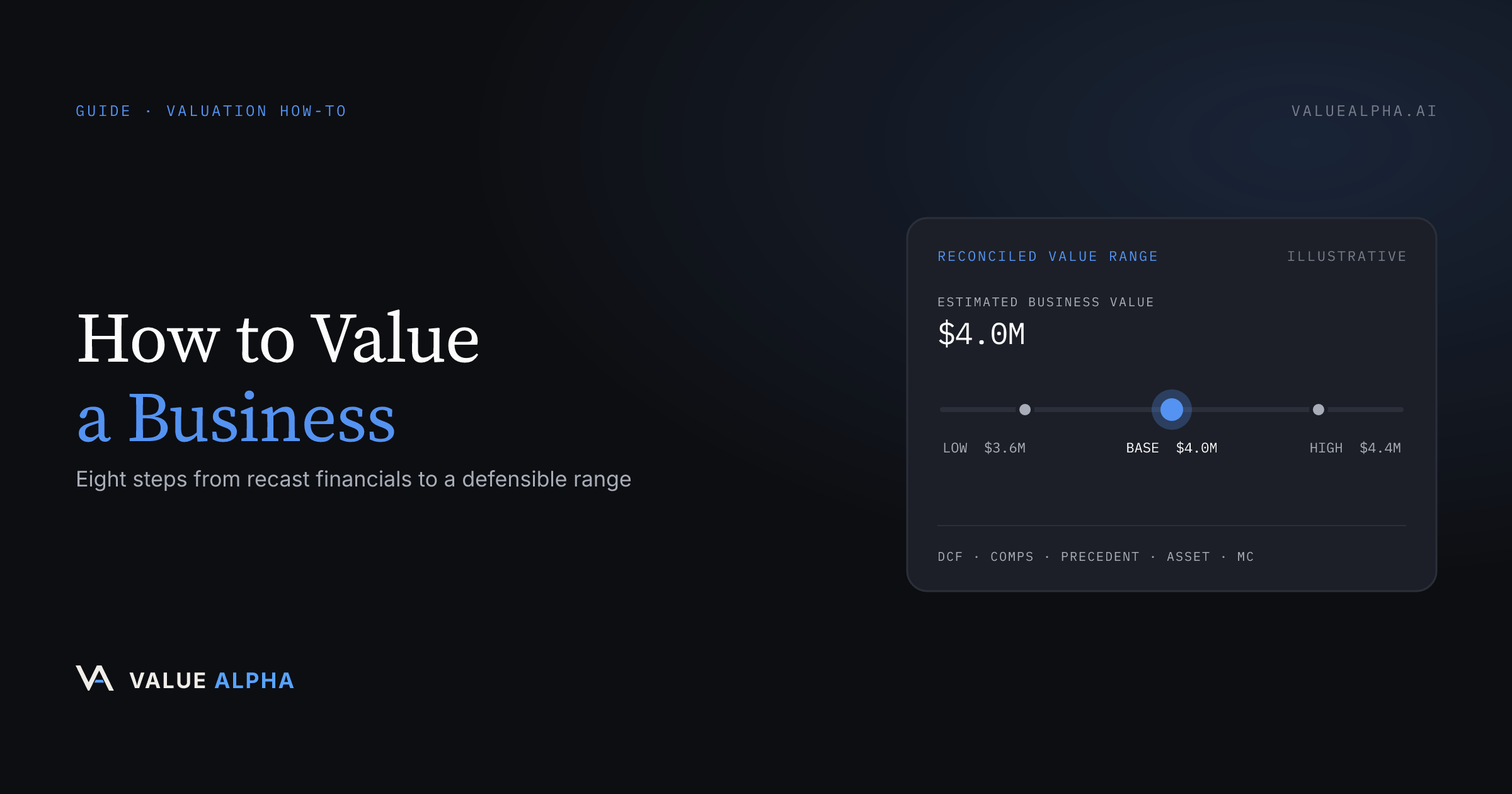
Produce a low, base, and high estimate rather than a point. The base is your weighted central estimate. The low and high reflect the bear and bull cases. A value expressed as "$3.6M to $4.4M, base $4.0M" is far more defensible and far more useful in a negotiation than a single confident-sounding number that is almost certainly wrong.
Step 7: Stress-test with scenarios and a sensitivity table
A valuation that only works under one set of assumptions is fragile. Pressure-test it before you rely on it.
Build a sensitivity table that flexes the two inputs the value is most sensitive to, usually the multiple (or discount rate) and the earnings/growth assumption:
| EBITDA / Multiple | 4.0x | 5.0x | 6.0x |
|---|---|---|---|
| $700K | $2.8M | $3.5M | $4.2M |
| $800K | $3.2M | $4.0M | $4.8M |
| $900K | $3.6M | $4.5M | $5.4M |
Then run named scenarios. A bear case might assume the largest customer leaves and margins compress. A bull case might assume a price increase sticks and a new location opens. Seeing the value swing across these tells you where the real risk sits, and it arms you for the questions a buyer, seller, or lender will ask. If you want this done automatically across thousands of simulations, that is what the paid engines on our pricing page cover.
Step 8: Document assumptions, sources, and an "as of" date
A number without its assumptions is a rumor. The final step is what separates a defensible valuation from a guess, and it is the step most people skip.
Write down, for every method:
- The assumptions you made (growth rate, discount rate, multiple, add-backs accepted and rejected).
- The source of every multiple and benchmark, so anyone can trace it back to real data.
- The "as of" date. Value changes with earnings, comps, and rates. A valuation is a snapshot, and the date is part of the answer. Six months later, the same business can be worth materially more or less.
This documentation is what makes your valuation hold up against a buyer's analyst, a seller's broker, or an SBA appraiser. It also lets future-you understand what past-you was thinking when the numbers move.
How to value a private business
A private business has no ticker and no daily quoted price, so there is no single number to check the way there is for a public stock. That absence is exactly why Steps 3 through 5 exist: build the income approach (DCF) from the company's own cash flow, build the market approach from comparable private companies and precedent transactions rather than public trading multiples, build the asset-based floor from the balance sheet, then triangulate the three into a range. Private comps and closed-deal data are also thinner and less current than public filings, which is why documenting the source behind every multiple (Step 8) matters even more for a private business than for a listed one. The output is still a range, not a point, because private-market pricing carries more uncertainty than a liquid public market does.
How to value a small business
A small business is valued through the owner's eyes, not a management team's, which is why Step 1 asks for SDE (seller's discretionary earnings) rather than EBITDA: SDE adds back the owner's full compensation because a buyer is really pricing the job of running the business, not just its cash flow. That choice cascades into the market approach in Step 4, where owner-operated small businesses commonly transact around 2x to 4x SDE rather than an EBITDA multiple, and it forces the buyer to underwrite whether they can actually replace the owner's hours and customer relationships. Get SDE right and a small business follows the same eight-step process as any other business; apply EBITDA to an owner-dependent business instead and the value comes out overstated before you have reconciled anything.
Frequently Asked Questions
What are the top 3 valuation methods?
The three core valuation methods are the income approach (a discounted cash flow, or DCF), the market approach (comparable companies and precedent transactions), and the asset-based approach (adjusted net asset value). Most operating businesses run the income and market approaches side by side, since both estimate the business as a going concern, and use the asset approach as a downside floor rather than a primary answer. Reconciling the outputs of these three methods, rather than picking just one, is what turns a guess into a defensible range.
How do I determine the value of my small business?
Start by calculating your seller's discretionary earnings (SDE), normalized owner-level earnings that add back your full compensation and any personal expenses run through the business; see the SDE formula for exactly how to calculate it. Then apply a market multiple appropriate to your size and sector, owner-operated small businesses commonly transact around 2x to 4x SDE, and cross-check the result against the asset-based floor and, where cash flow is stable, a simple DCF. Reconcile those into a low, base, and high range rather than a single figure, since that is what actually holds up when a buyer, lender, or partner pushes back on the number.
Common mistakes
- Valuing on the wrong earnings metric. Using SDE for a business that needs a hired manager overstates value badly. Match SDE and EBITDA to the buyer.
- Trusting the asking price. Brokers price to market the deal. Start from cash flow, not the listing.
- Forcing a single number. Every honest valuation is a range with a confidence level. Collapsing it to one figure hides the risk.
- Aggressive add-backs. Add-backs a buyer or appraiser will not accept shrink normalized earnings and the valuation with them. Be conservative.
- Ignoring the date. A valuation with no "as of" date cannot be trusted, because it cannot be reproduced.
- Skipping the floor. Without the asset approach you have no downside boundary, and no way to spot an underperforming business.
Ready to value your business?
You can run the full eight-step process by hand in a spreadsheet, and for a high-stakes deal it is worth doing. But for a fast, grounded starting point, run the business valuation calculator. It applies the same income and market logic across thousands of SMB comps and returns a low, base, and high range with a confidence score in under a minute, so you can decide whether the full workup is worth your time. Either way, the discipline is the same: normalize the financials, run the right methods, reconcile to a range, and document every assumption with a date.
Frequently Asked Questions
How much does it cost to value a business?
Which valuation method is best?
Can I value my own business?
What multiple should I use to value my business?
Is a business valuation the same as a formal appraisal?
Why is a valuation a range instead of one number?
Valuation intelligence, once a month.
Valuation insights, best practices, and market multiple trends. Delivered the first Tuesday of every month. Written for searchers, advisors, and owners who want to stay sharp.
Free · No spam · Unsubscribe anytime

Tomasz Felpel
Founder & CEO, Value Alpha
Columbia Business School MBA and founder of Value Alpha. Former Global Business Development Manager at IFF, where he contributed to a multibillion-dollar Fortune 500 merger. VP of Startup Lab at Columbia Entrepreneurship Organization.
LinkedInRelated Guides
Free Business Valuation Calculator - How It Works and How to Use It
Free business valuation calculator powered by 11,000+ SMB comps. Get a VA Range in under a minute - bear, base, and bull estimates with a confidence score. No signup, no credit card.
ConceptsWhat Is Alpha in Private Business? The Five Sources of Excess Returns
Alpha in private markets is excess return above a benchmark. Five sources: information asymmetry, operational improvements, multiple arbitrage, valuation gaps, and roll-ups.