

Summary
Valuing a limited company (an LLC in the US, a Ltd in the UK, or an equivalent private company elsewhere) is not one calculation. It is a disciplined process: clean up the earnings, run two or three valuation approaches that fit the business, bridge from the value of the enterprise to the value of the shares, apply the discounts that private ownership demands, and reconcile the result into a range you can defend.
The complication that sets a limited company apart from a sole trader or a listed business is ownership structure. The company is a separate legal entity, it carries its own debt, and its shares are private and often held by more than one person. That means two extra questions on top of the core valuation: are you valuing the whole enterprise or just the equity, and are you valuing a controlling stake or a minority one? Get those wrong and the number is meaningless.
This guide walks through the full process. If you want a fast directional read before you start, run the business valuation calculator for a grounded range in seconds, then come back and do the full work below when the number actually matters.
Step 1: Normalize the P&L with owner add-backs
Every valuation is only as good as the earnings figure underneath it, and in a private limited company the reported profit is almost never the real economic profit. Owners manage the accounts for tax, not for a buyer, so before you touch a multiple or a discount rate you have to recast the profit and loss.
Pull three years of statutory accounts plus a current year-to-date interim statement, then strip out the distortions:
- Owner add-backs. Above-market director or owner salary, family on the payroll who do not work in the business, personal vehicles, personal travel, home office costs, and any perk that will not transfer to a buyer.
- One-time items. Legal settlements, a restructuring, a failed product launch, a one-off grant, or any expense that will not recur.
- Non-operating items. Rent paid to a related party above or below market, investment income, and assets or costs unrelated to the trade.
This produces the earnings base you actually value on:
- EBITDA keeps a market-rate manager salary in the expenses. Use it for companies that already run on a management team, which most limited companies of any size do.
- SDE (seller's discretionary earnings) adds back one full owner's total compensation. Use it for small owner-operated companies where one person runs the show.
Match the metric to the buyer. A buyer who will hire a manager values on EBITDA, not SDE. Get the earnings base right and everything downstream gets easier.
Step 2: Equity value or enterprise value?
This is the question that trips up more private-company deals than any other, so settle it before you calculate anything.
Enterprise value is the value of the whole operating business, independent of how it is financed. It is what the trade is worth to an owner who takes on the assets and the operations.
Equity value is what the shareholders actually own once the company's debts are settled. It is the cash that reaches the people who hold the shares.
The three valuation approaches in the next steps almost all produce an enterprise value. But a shareholder is selling equity. The two are linked by the net debt bridge, which we run in Step 6. The practical rule: buyers make offers on an enterprise-value basis, so a seller must always convert to equity value before celebrating, because a company with a lot of debt can have a healthy enterprise value and a thin equity value.
Step 3: Run the income approach (DCF)
A discounted cash flow values the company by what it will earn in the future, discounted back to today. It is the most theoretically sound approach and the one that forces honesty about growth.
Build it in four parts:
- Projections. Forecast free cash flow for five years. Start from normalized earnings, subtract tax, add back depreciation, then subtract capital expenditure and changes in working capital. Anchor growth to history and to what the market can support, not to hope.
- WACC (the discount rate). This is the return a buyer demands for the risk. For a small private company it commonly lands well above a listed-company rate, because private small companies carry more risk and less liquidity. A higher discount rate means a lower value.
- Terminal value. Most of the value sits beyond year five. Estimate it with a modest perpetuity growth rate (never above long-run GDP) or an exit multiple, then discount it back.
- Sum and sanity-check. Discount each year's cash flow plus the terminal value to today. The total is your enterprise value from the income approach.
The discount rate and terminal assumptions drive the answer more than anything else, which is exactly why you stress-test them before you rely on the number. For more on how WACC and discount rates work in practice, see our guide on how to value a business.
Step 4: Run the market approach (comparables)
The market approach answers a simpler question: what have buyers actually paid for companies like this one? It comes in two flavors.
Comparable companies look at trading multiples (EV/EBITDA, EV/Revenue, EV/SDE) of similar businesses. For a private limited company, the cleanest version is applying an industry multiple to your normalized earnings.
Precedent transactions use the multiples paid in real closed deals for comparable companies. These are the most persuasive evidence in a negotiation because they reflect what someone actually paid.
Apply a sector-appropriate multiple to your normalized EBITDA or SDE. As general, illustrative context, owner-operated small companies often transact around 2x to 4x SDE, while larger management-run businesses commonly trade in the 4x to 7x EBITDA range, with software and high-growth recurring-revenue companies going higher. Treat these as starting points, not facts. A clean comp result looks like: normalized EBITDA of $800,000 x a 5.0x sector multiple = $4.0M enterprise value. Then ask whether your company deserves a premium or a discount to the sector median, and adjust. Note that the multiple is applied to reach enterprise value, not equity value.
Step 5: Establish the asset-based floor
The asset approach sets the downside boundary. It tells you what the company is worth on its balance sheet rather than its earnings.
Take total assets at fair market value (not book value) and subtract total liabilities. That is adjusted net asset value. For a going concern, mark real estate and equipment to current market, write down stale inventory and uncollectible receivables, and recognize assets the books understate.
For most healthy, profitable companies the asset value comes in below the income and market values, and that is the point: a company earning strong cash flow should be worth more than its parts. When the asset floor exceeds your earnings-based values, that is a red flag, either the company is underperforming its assets or the projections are too pessimistic. Asset-heavy companies (manufacturing, distribution, transport) lean on this approach more heavily; service companies use it only as a sanity-check floor.
Step 6: Bridge from enterprise value to equity value
You now have a reconciled enterprise value from the three approaches. But the shareholders are selling equity, so you have to cross the net debt bridge.
Start from enterprise value and adjust:
- Subtract interest-bearing debt. Bank loans, invoice finance, leases, and any borrowing the buyer inherits.
- Add surplus cash. Cash beyond what the business needs to operate day to day.
- Adjust for debt-like items. Unpaid tax, a pension deficit, deferred consideration from a past deal, overdue payables, and director or shareholder loans all behave like debt and reduce equity value.
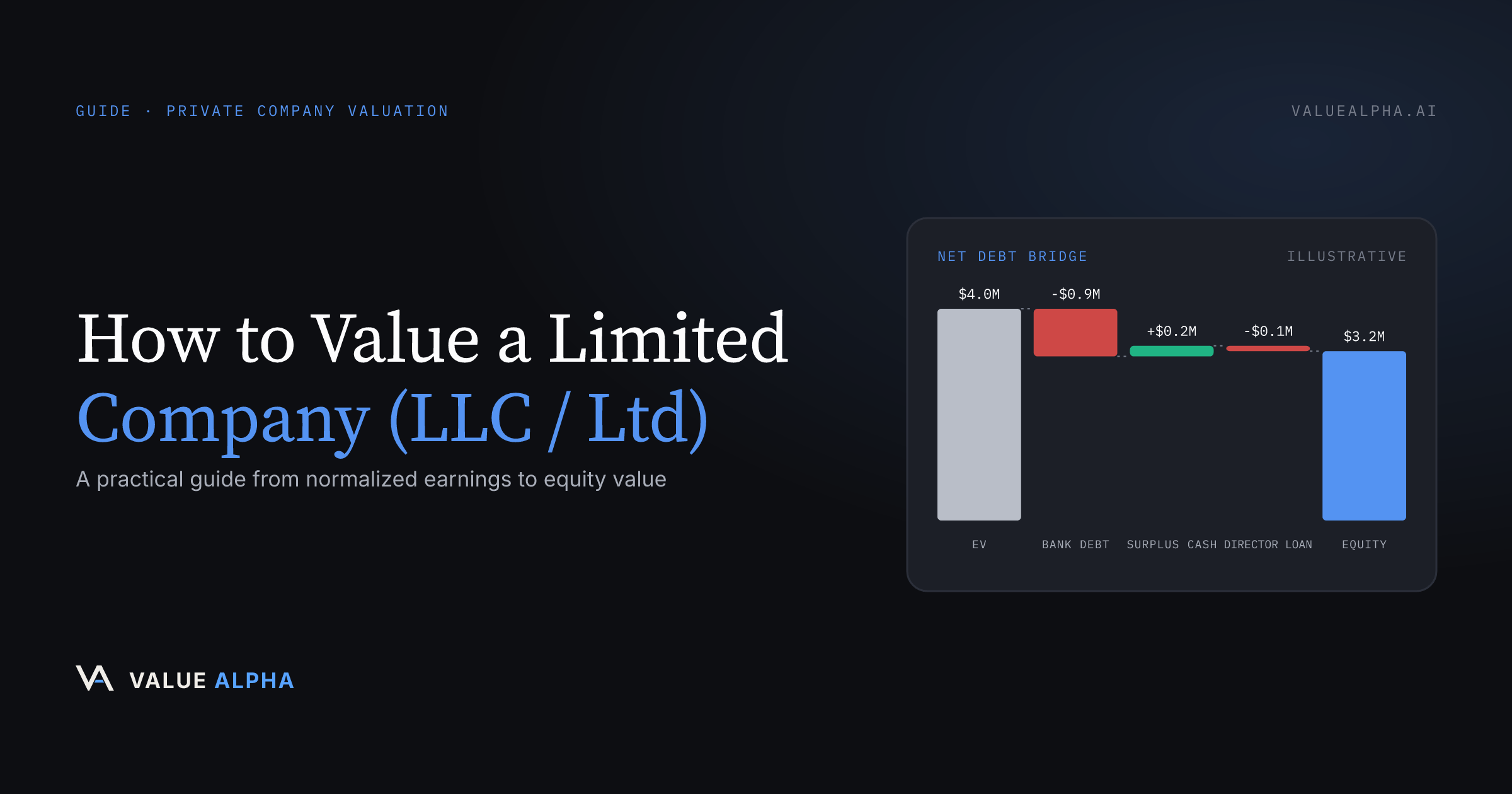
The result is equity value: what the owners receive. A worked example: enterprise value of $4.0M, less $900,000 of bank debt, plus $200,000 of surplus cash, less a $100,000 director loan, gives an equity value of $3.2M. Two companies with the same enterprise value can deliver very different equity value depending on the balance sheet, which is exactly why Step 2 insisted you be explicit about what is being sold.
Step 7: Apply minority and marketability discounts
The enterprise and equity values above are computed on a control basis for a hypothetical marketable interest. Private shares are usually neither, so two discounts may apply.
Minority (lack of control) discount. A minority shareholder cannot set dividends, strategy, salaries, or force a sale. That lack of control makes each share worth less than a share in a controlling block. So a 25 percent holding is usually worth materially less than 25 percent of the whole-company equity value. The size depends on how much the minority is actually blocked from, which is often set out in the shareholder or operating agreement.
Discount for lack of marketability (DLOM). Even a controlling stake in a private company cannot be sold quickly at a quoted price the way a listed share can. There is no exchange, a buyer has to be found, and due diligence takes months. That illiquidity is worth less, so a DLOM is applied to almost every private holding. The size is a matter of judgement based on the facts, not a fixed percentage.
Apply the discounts in sequence to the pro-rata equity value, and always read the shareholder or operating agreement first, because a pre-agreed buyout formula can override the whole calculation.
Step 8: Reconcile into a defensible range and document it
Now you have three enterprise-value answers that disagree, a net debt bridge, and one or two discounts. The job is not to pick a winner; it is to weight the approaches by relevance, run the bridge, apply the discounts, and produce a range.
Weighting depends on the company type: stable service companies lean on the market approach, high-growth and recurring-revenue companies lean on DCF, and asset-heavy or marginal earners lean on asset value and EBITDA multiples. Produce a low, base, and high equity value rather than a point. A value expressed as "$2.9M to $3.5M, base $3.2M" is far more defensible and far more useful in a negotiation than a single confident-sounding number that is almost certainly wrong.
Then document it. Write down, for every approach, the assumptions you made, the source of every multiple and benchmark, and a clear as-of date. A valuation is a snapshot, and the same company can be worth materially more or less six months later. This documentation is what makes the number hold up against a buyer's analyst, a co-shareholder's advisor, or a tax authority.
Common mistakes
- Confusing equity value with enterprise value. Offering on enterprise value and paying out as if it were equity value overstates what shareholders receive. Always cross the net debt bridge.
- Ignoring debt-like items. Unpaid tax, pension deficits, and director loans quietly shrink equity value and are the classic due-diligence surprise.
- Skipping the minority discount. Valuing a 25 percent stake at a flat 25 percent of the whole company overstates it. A non-controlling share is worth less per share.
- Forgetting the DLOM. Private shares are illiquid. Pricing them as if they trade on an exchange overvalues them.
- Aggressive add-backs. Add-backs a buyer or appraiser will reject shrink normalized earnings, and the valuation with them.
- Ignoring the shareholder agreement. A pre-agreed buyout clause can override the whole calculation. Read it before you model anything.
Ready to value your limited company?
You can run the full process by hand in a spreadsheet, and for a share sale or a director buyout it is worth doing. But for a fast, grounded starting point, run the business valuation calculator. It applies the same income and market logic across thousands of comparable companies and returns a low, base, and high range in under a minute, so you can decide whether the full workup is worth your time. Either way the discipline is the same: normalize the earnings, run the right approaches, bridge to equity value, apply the private-company discounts, reconcile to a range, and document every assumption with a date.
Frequently Asked Questions
How do you value a private limited company?
What is the difference between equity value and enterprise value?
What is a marketability discount (DLOM)?
How do you value a minority shareholding?
What multiple should I use to value a limited company?
Do I need a formal valuation or is an estimate enough?

Tomasz Felpel
Founder & CEO, Value Alpha
Columbia Business School MBA and founder of Value Alpha. Former Global Business Development Manager at IFF, where he contributed to a multibillion-dollar Fortune 500 merger. VP of Startup Lab at Columbia Entrepreneurship Organization.
LinkedInRelated Guides
How-To
How to Value a Business: A Step-by-Step Guide
A practical, step-by-step guide to valuing a business: recast the financials, pick the right methods, run DCF, comps, and the asset floor, then reconcile into a defensible range.
How-To
How to Value a Startup: Methods That Actually Work
A practical guide to valuing a startup at any stage: why earnings multiples and DCF break down, and how to use Scorecard, Berkus, the VC method, revenue multiples, comparable rounds, and scenario-weighted First Chicago to reach a defensible range.