

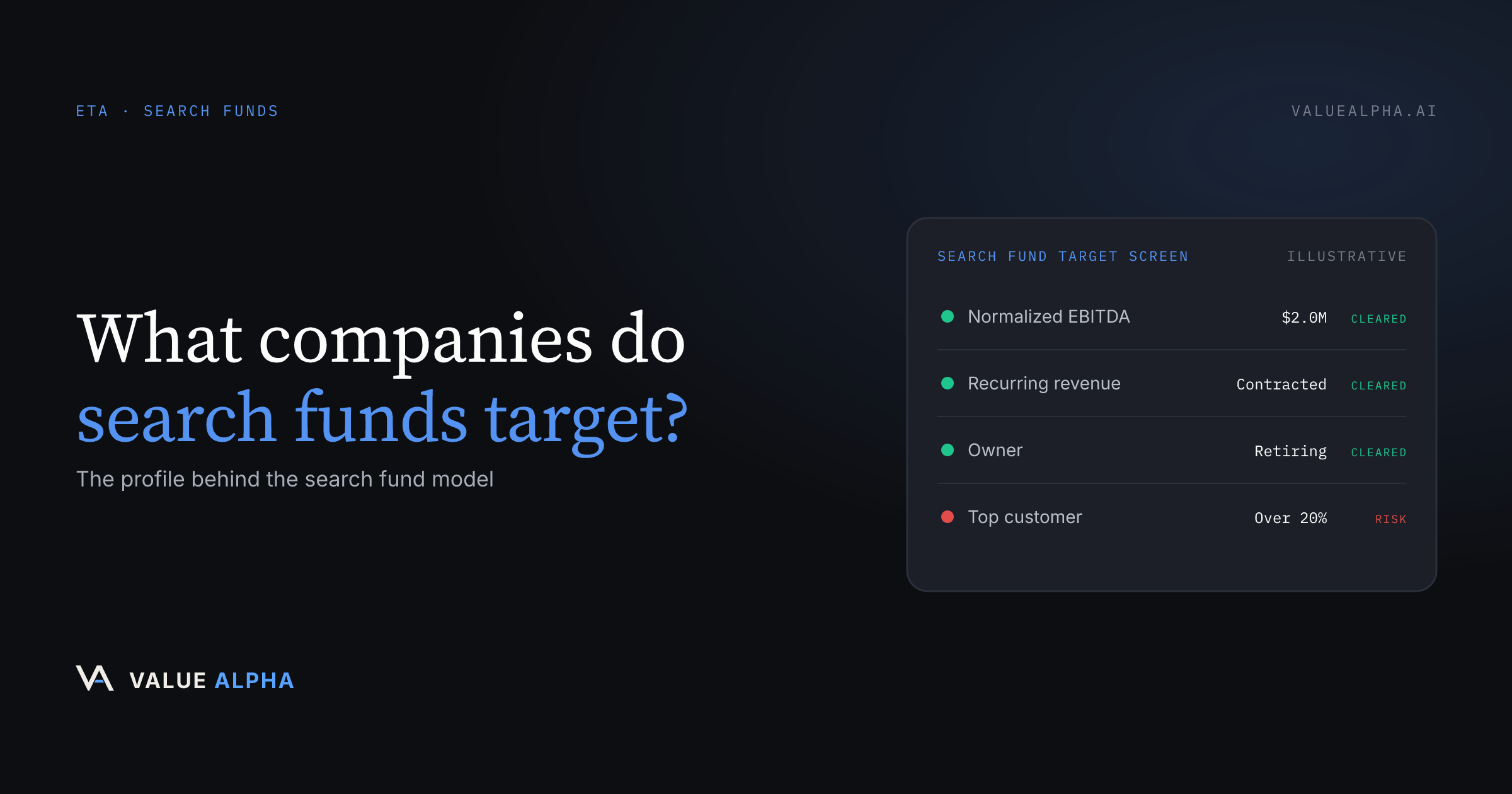
Search funds target established, profitable, owner-operated private companies with recurring or repeat revenue, low capital intensity, a fragmented competitive set and a retiring owner, typically in the lower middle market, where EBITDA sits between roughly $1M and $5M and multiples run 4.5x to 7x. The reason is arithmetic: a single operator with SBA or seller-note leverage needs stable cash flow to service debt and enough size to hire a bench, and the price paid relative to normalized earnings is where most searches are won or lost.
A search fund is a vehicle through which one or two operators, usually first-time CEOs, raise capital to find, buy and run a single private company. The target profile follows from that structure: one company, bought largely with debt, run by someone new to it.
What companies do search funds target?
Companies that can carry acquisition debt and survive a change of CEO, which comes down to five traits:
- Earnings big enough to pay a CEO and a lender. Traditional, investor-backed search funds commonly look for roughly $1M to $5M of EBITDA. Self-funded searchers, who usually finance with an SBA 7(a) loan capped at $5 million, more often buy at $500K to $1M of SDE.
- Recurring or repeat revenue. Service contracts, subscriptions, or customers who reorder on a schedule.
- A fragmented market. Many small competitors and no dominant player setting prices.
- An owner ready to leave. Typically a retiring founder with no family successor, willing to stay through a transition and often to carry a seller note.
- Low capital intensity. Little capex needed to keep running, so EBITDA turns into cash.
What searchers avoid follows the same logic: cyclical demand, heavy capex, technology risk, turnarounds, unprofitable companies, and businesses that are mostly the owner's license or relationships. A first-time CEO carrying debt cannot afford a bad first year. Stanford GSB's biennial Search Fund Study tracks the sizes and industries of the companies searchers actually buy, and the buy box template turns these traits into screening criteria for your pipeline.
Why does the search fund model need this profile?
Because every trait protects one of two things: the debt service, or the handover to a new operator.
| Target attribute | Why the leveraged single-operator model needs it | Where it shows in the price |
|---|---|---|
| Earnings size ($1M to $5M EBITDA) | Pays a market-rate CEO, a lender and a small management bench out of the same cash flow | Sets the band: roughly 4.5x to 6x EBITDA at $1M to $3M, 5.5x to 7x at $3M to $5M |
| Recurring or repeat revenue | Makes next year's debt payment predictable before the new CEO has learned the business | Pushes toward the top of the band; one-off project revenue pushes toward the bottom |
| Fragmentation | Leaves room to grow organically or through small add-ons without a dominant competitor setting prices | Supports the exit multiple more than the entry multiple; consolidated sectors are priced by strategic buyers |
| Owner situation (retiring, no successor) | Supplies a motivated seller who will transition customers and accept deferred consideration | A seller note or earnout narrows the gap between asking and paying; owner-held relationships cost a discount |
| Capital intensity (low) | Turns EBITDA into cash that services debt instead of replacing equipment | Heavy capex is priced as a lower EBITDA multiple, or valued on EBITDA minus capex |
The size bands match the deal-size table in business valuation multiples by industry; check them against completed deals for your sector in the IBBA Market Pulse survey or DealStats.
How does the target profile show up in the price?
Through the lender's math. Take an illustrative company with $2M of normalized EBITDA, after a market-rate CEO. At 6x the price is $12M. Finance half with senior debt at 9% over seven years and debt service is about $1.2M a year, covered roughly 1.7 times, comfortably above the minimum of around 1.15x lenders commonly underwrite to. If EBITDA falls 20% in year one, coverage drops to about 1.3x: tight, but survivable.
Pay 7.5x instead. The price is $15M, the same structure means $7.5M of senior debt and about $1.5M of annual debt service, and coverage starts near 1.3x. The same 20% dip takes it to about 1.1x, below what most lenders accept, before taxes and capex make it tighter still. Same business, same operator: the only change is a turn and a half of price.
Recurring revenue and low capex make the dip less likely; a fragmented market and a retiring owner are where you can buy without paying 7.5x. The search is won at the letter of intent, so setting the valuation range in the LOI deserves more of your time than the search deck.
Which sectors do searchers over-target, and which do they ignore?
This part is my opinion. Almost every search thesis says "B2B services with recurring revenue", and the filter is right. The problem is that hundreds of searchers apply it to the same short list of sectors, so the best fits attract the most bidders, including private equity add-on buyers with cheaper capital.
Crowded:
- IT managed services: contracted monthly revenue at 3x to 5x SDE, and a PE-backed roll-up bidding on nearly every MSP worth owning.
- HVAC and plumbing and pest control: service agreements and route density are exactly what consolidators buy, so the good ones clear at the top of their bands.
- Insurance brokerage and vertical SaaS: priced at 8x to 12x and 8x to 15x EBITDA, which a searcher's debt structure rarely supports.
Overlooked:
- Commercial equipment maintenance: service contracts on installed equipment, unglamorous, often run by a founder near retirement.
- Security systems integration: monitoring and service revenue on top of installs; price the recurring share.
- Property management: doors under management renew every year, at 3x to 5x SDE.
- Commercial landscaping maintenance and value-added distribution: repeat local revenue in fragmented markets most search decks never mention.
The crowded sectors are not bad businesses. But the same quality bought where fewer people are bidding leaves a turn or two of multiple on your side of the table, and the arithmetic above shows what a turn is worth.
Frequently Asked Questions
How is a self-funded search target different from a traditional search fund target?
It is smaller and shaped by the SBA. A self-funded searcher pays for the search personally and usually finances the purchase with an SBA 7(a) loan (capped at $5 million, with an equity injection of at least 10%) plus a seller note, so targets typically sit at $500K to $1M of SDE, at roughly 2.5x to 4x. A traditional search fund raises search capital from investors up front and buys larger. The SBA 7(a) valuation requirements cover the lender's side.
How much customer concentration will a search fund accept?
Less than most sellers expect. Buyers commonly start cutting the multiple once a single customer passes roughly 15% to 20% of revenue, and above 30% many restructure the deal around earnouts or cannot get it financed. Customer concentration sets out the bands.
How should a searcher value a target once it fits the profile?
Normalize the earnings, anchor to completed-deal multiples for its size and sector, adjust for risk, and set a range rather than a point; how to value an acquisition target walks through each step. Value Alpha runs that analysis against 9,000+ completed transactions and returns a VA Range, bear, base and bull with a VARI reliability score; the buyer-side workflow shows how searchers use it before an LOI.
Key Takeaways
- Search funds target profitable, owner-run companies with recurring revenue, low capex, a fragmented market and a retiring owner.
- Traditional search funds typically buy at $1M to $5M of EBITDA and 4.5x to 7x; self-funded searchers buy smaller, at $500K to $1M of SDE with SBA 7(a) debt.
- Every trait protects either the debt service or the handover to a first-time CEO.
- A turn and a half of purchase multiple can move debt coverage from comfortable to below lender minimums.
- The most-targeted sectors carry the most bidders: the same quality in an overlooked sector leaves room on price.

Tomasz Felpel
Founder & CEO, Value Alpha
Columbia Business School MBA and founder of Value Alpha. Former Global Business Development Manager at IFF, where he contributed to a multibillion-dollar Fortune 500 merger. VP of Startup Lab at Columbia Entrepreneurship Organization.
LinkedInRelated Articles
ETAsearch fundsM&A advisorybusiness buyersacquisitionLOI
How to Value an Acquisition Target: A Search Funder's Framework for Setting Your LOI Range
How search fund and ETA buyers value an acquisition target: normalize SDE or EBITDA, anchor to lower-middle-market multiples, and set an LOI range a lender will underwrite.
July 20, 2026 · 11 min
LOIdeal structureETAsearch fundsbusiness buyersM&A advisory
How to Set a Valuation Range in an LOI: A Searcher's Guide
How searchers and self-funded buyers set a defensible LOI valuation range before diligence: the multiple bands, the four discounts to price in, and how wide to leave the range.
July 15, 2026 · 8 min
customer concentrationriskselling a businesssmall business ownersM&A advisorysellers
Customer Concentration: The Silent Discount on Your Business's Value
When one customer is 20% or more of revenue, buyers cut the price, restructure the deal, or walk. Here's how concentration is measured, what it costs in practice, and the 18-month fix.
July 31, 2026 · 7 min
From Our LinkedIn
Follow us for valuation insights and industry analysis
Value Alpha
Valuing a private company should not be a black box. Upload the financials and get a defensible bear, base and bull range with every figure traced back to the document it came from. Multiple engines. Sector-specific.
Value Alpha
Not all businesses are valued the same way. A biotech with a drug pipeline needs Pipeline SOTP analysis. A manufacturing company needs asset-based valuation. An IT services firm needs comparable companies. Value Alpha calibrates engines by industry.
Value Alpha
Scenario analysis: change the debt paydown, the growth rate or the margin, and watch the range move. Every engine reruns and the drivers are shown, so you can see which assumption is carrying the value.