

Thinking Like a Buyer
Most business owners think about their company from the inside out: products, team, customers, revenue. Buyers think from the outside in: risk, return, and transferability. Understanding this shift in perspective is the difference between a valuation that gathers dust and one that closes a deal.
1. Earnings Quality
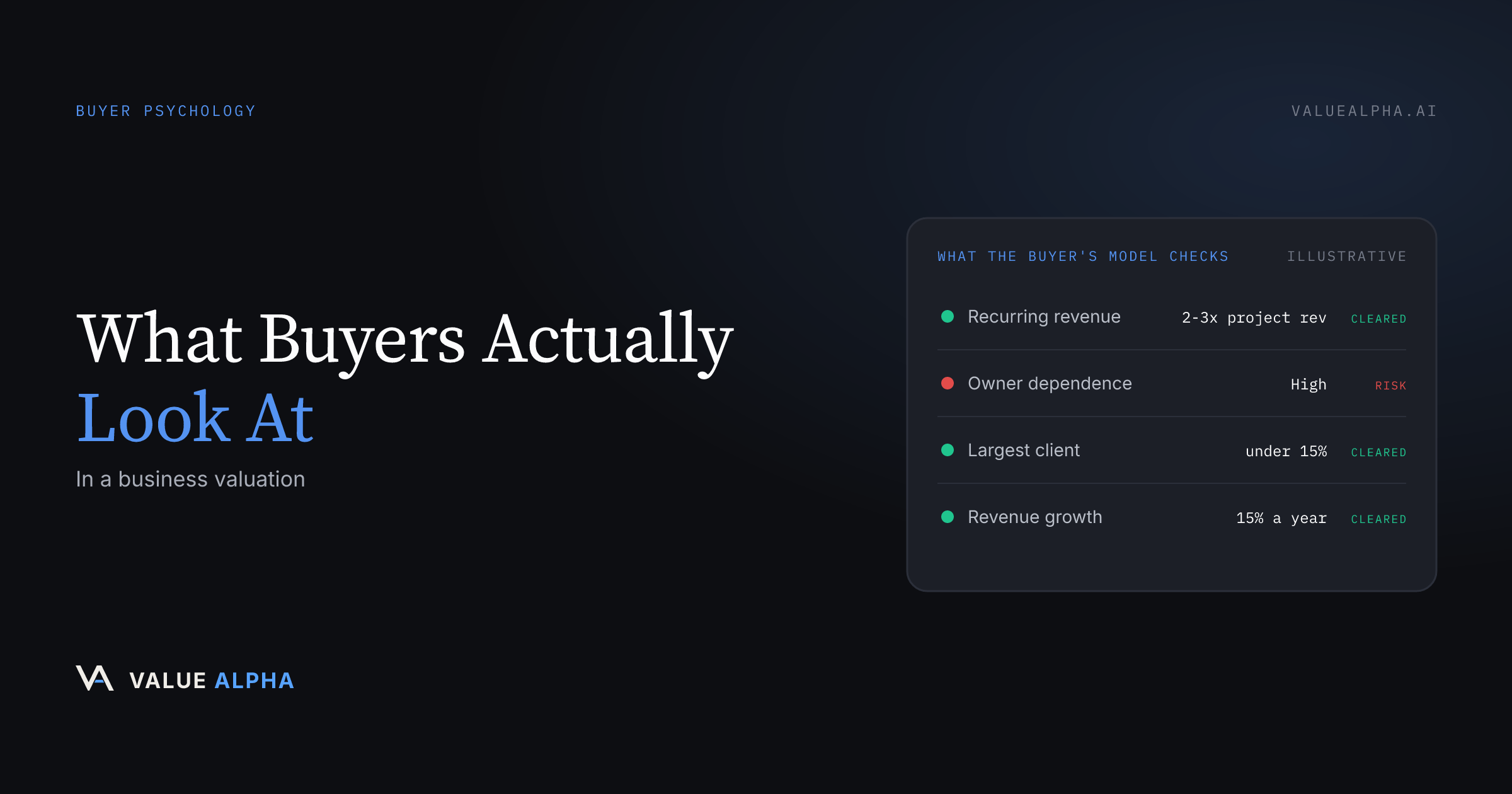
Buyers don't just look at how much you earn - they look at how reliable those earnings are. Recurring revenue (subscriptions, retainers, maintenance contracts) is valued at 2–3x the multiple of project-based revenue, even at the same dollar amount.
What strengthens this: Long-term contracts, documented renewal rates, low customer churn, diversified revenue streams.
2. Growth Trajectory
A business growing at 15% annually commands a meaningfully higher multiple than one growing at 3% - even with identical current earnings. Growth is where future cash flows come from, and DCF models are extremely sensitive to it.
What strengthens this: 3+ years of consistent growth, a clear pipeline, market tailwinds (growing TAM), and documented go-to-market efficiency.
3. Owner Dependence
This is the silent killer of valuations. If the business can't function without the founder - if key relationships, operational knowledge, or sales depend on one person - buyers apply a 15–25% discount. Sometimes they walk away entirely.
What strengthens this: A capable #2, documented processes, client relationships distributed across the team, and the owner already working "on" the business rather than "in" it.
4. Customer Concentration
If your top client represents 30%+ of revenue, that's a risk flag. If they leave after the acquisition, the buyer just lost a third of what they paid for.
What strengthens this: No single client above 15% of revenue, diversified across industries and geographies, long tenure relationships with written agreements.
5. Clean Financials
This isn't about fraud - it's about clarity. Buyers want to see financials that are easy to understand, consistently prepared, and free of personal expenses mixed with business operations. The easier your books are to diligence, the faster (and higher) the offer.
What strengthens this: Professional bookkeeping, clear separation of personal and business expenses, tax returns that match financial statements, and normalized earnings with documented add-backs.
How to Use This
Before you get a valuation, run through these five factors honestly. Each one you can strengthen before going to market adds real value - not just on paper, but in the negotiation room.
Valuation intelligence, once a month.
Valuation insights, best practices, and market multiple trends. Delivered the first Tuesday of every month. Written for searchers, advisors, and owners who want to stay sharp.
Free · No spam · Unsubscribe anytime
ValueAlpha Team
Finance & AI Experts
MBA-trained valuation professionals and engineers building the future of private company valuation. We combine institutional finance methodologies with AI to make defensible valuations accessible to every business owner.
LinkedInRelated Articles
March 17, 2026 · 6 min
How to Prepare Your Business for a Valuation
The 7 documents and data points you need before running a business valuation - and how each one impacts your final number.
March 10, 2026 · 4 min
Why Your Business Valuation Is a Range, Not a Number
A single valuation number is a red flag. Here's why serious buyers, investors, and advisors always think in ranges - and how to interpret yours.
From Our LinkedIn
Follow us for valuation insights and industry analysis
Value Alpha
Valuing a private company should not be a black box. Upload the financials and get a defensible bear, base and bull range with every figure traced back to the document it came from. Multiple engines. Sector-specific.
Value Alpha
Not all businesses are valued the same way. A biotech with a drug pipeline needs Pipeline SOTP analysis. A manufacturing company needs asset-based valuation. An IT services firm needs comparable companies. Value Alpha calibrates engines by industry.
Value Alpha
Scenario analysis: change the debt paydown, the growth rate or the margin, and watch the range move. Every engine reruns and the drivers are shown, so you can see which assumption is carrying the value.