

The Myth of the Perfect Number
"What's my business worth?" is the most common question we hear. And the honest answer is always: it depends.
Not because we're hedging - but because a business has different values to different buyers, under different assumptions, at different times. Any tool that gives you a single number is hiding the uncertainty that every sophisticated buyer already understands.
Why Multiple Methods Exist
Each valuation methodology answers a slightly different question:
- DCF (Discounted Cash Flow): What are the future cash flows worth today, given the risk? This is forward-looking and assumption-heavy.
- Comparable Companies: What are similar public companies trading at? This reflects current market sentiment.
- Precedent Transactions: What have buyers actually paid for similar businesses? This reflects real deal economics, including control premiums.
Each method has blind spots. DCF is sensitive to growth assumptions. Comps may not reflect private company discounts. Precedent deals may be stale or from different market conditions.
How to Read Your Range
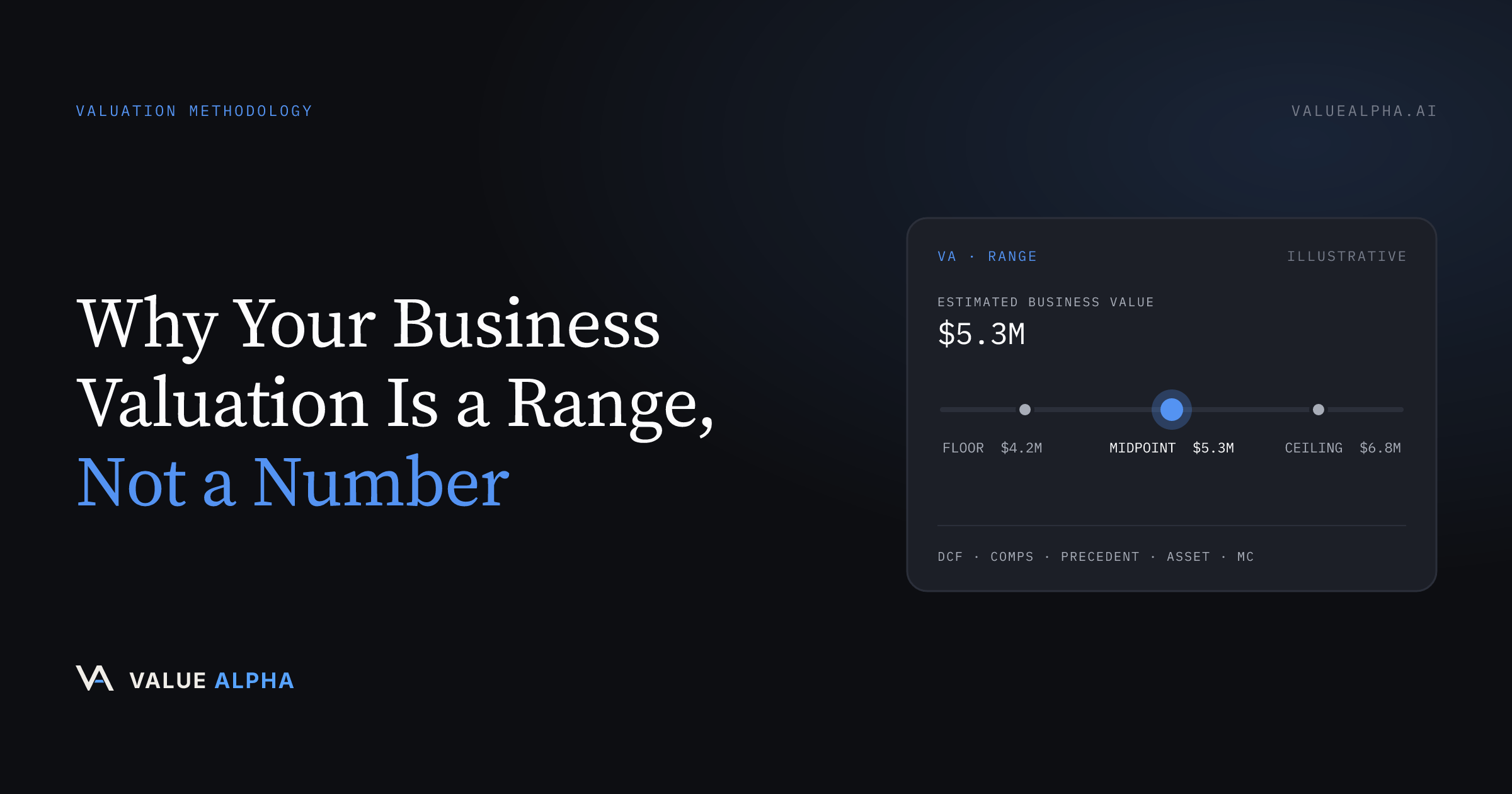
A valuation range of $4.2M – $6.8M with a midpoint of $5.3M tells you:
- The floor ($4.2M): What you'd likely get in a distressed or quick sale
- The midpoint ($5.3M): The most probable value given current data
- The ceiling ($6.8M): What you could achieve with competitive bidding and strong negotiation
The width of the range itself is information. A narrow range (±10%) means high confidence - the methods agree. A wide range (±40%) means significant uncertainty - and that's a signal to gather more data or address the assumptions driving divergence.
What Narrows the Range
- More financial history (3+ years of audited statements)
- More comparable data (peers in your exact NAICS code)
- Clearer growth trajectory (documented pipeline or contracts)
- Lower key-person risk (the business runs without the founder)
The Bottom Line
A range is not a weakness - it's intellectual honesty. When you sit across from a buyer or investor, showing that you've thought about your valuation from multiple angles builds credibility. A single number invites challenge. A well-reasoned range invites negotiation.
Valuation intelligence, once a month.
Valuation insights, best practices, and market multiple trends. Delivered the first Tuesday of every month. Written for searchers, advisors, and owners who want to stay sharp.
Free · No spam · Unsubscribe anytime
ValueAlpha Team
Finance & AI Experts
MBA-trained valuation professionals and engineers building the future of private company valuation. We combine institutional finance methodologies with AI to make defensible valuations accessible to every business owner.
LinkedInRelated Articles
February 16, 2026 · 6 min
DCF Analysis Explained for Private Companies
A clear, practical guide to discounted cash flow analysis for private companies. Learn the five key steps, how to estimate WACC without public market data, terminal value approaches, and common pitfalls to avoid.
March 24, 2026 · 5 min
What Buyers Actually Look At in a Business Valuation
Forget vanity metrics. Here are the 5 factors that move the needle when a buyer evaluates your business - and how to strengthen each one.
From Our LinkedIn
Follow us for valuation insights and industry analysis
Value Alpha
Valuing a private company should not be a black box. Upload the financials and get a defensible bear, base and bull range with every figure traced back to the document it came from. Multiple engines. Sector-specific.
Value Alpha
Not all businesses are valued the same way. A biotech with a drug pipeline needs Pipeline SOTP analysis. A manufacturing company needs asset-based valuation. An IT services firm needs comparable companies. Value Alpha calibrates engines by industry.
Value Alpha
Scenario analysis: change the debt paydown, the growth rate or the margin, and watch the range move. Every engine reruns and the drivers are shown, so you can see which assumption is carrying the value.