

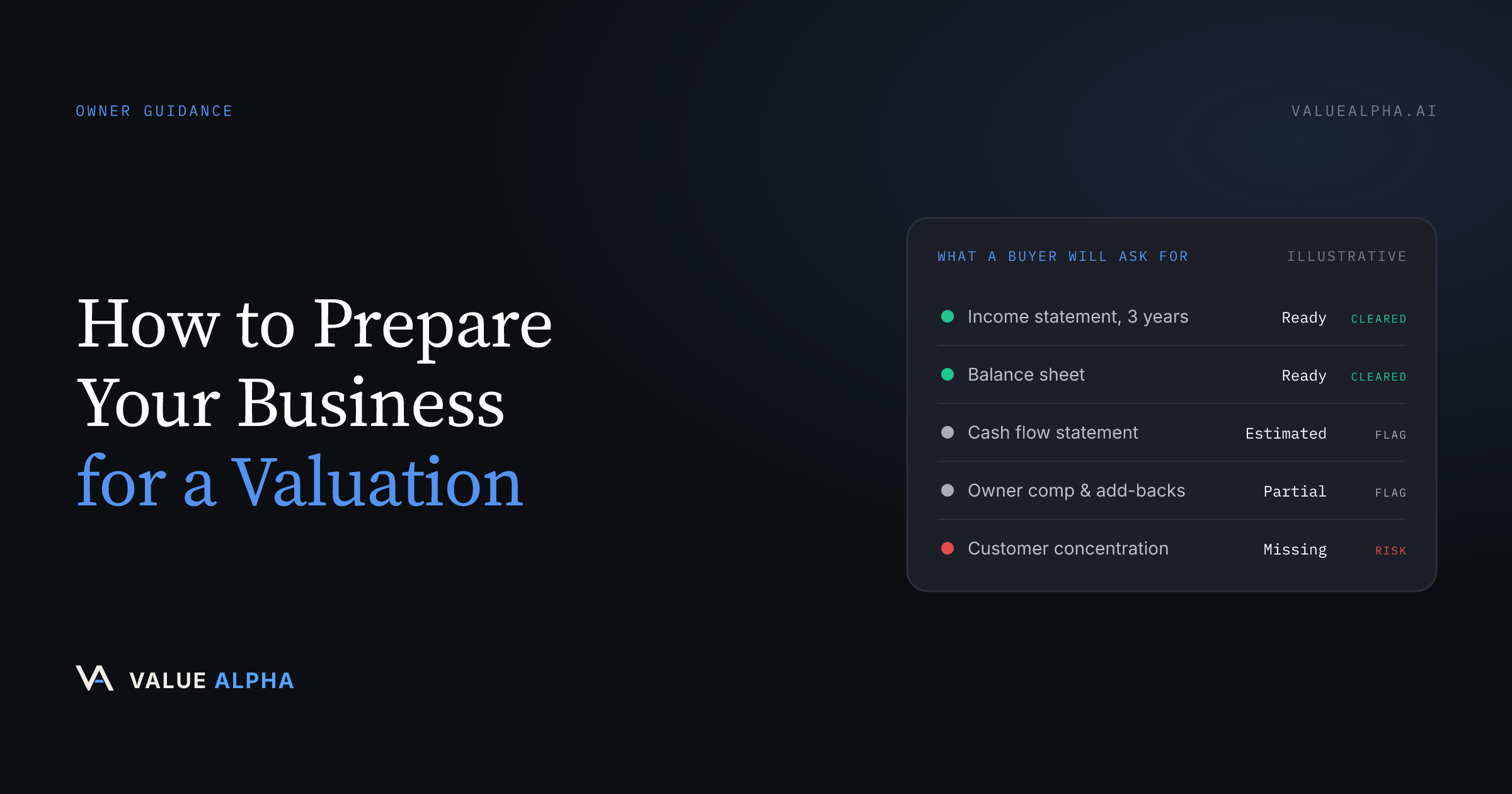
Before You Start: Gather Your Data
The quality of a valuation is directly proportional to the quality of its inputs. Garbage in, garbage out. Here's exactly what you need - and why each item matters.
1. Income Statement (Required)
This is the foundation. Revenue, cost of goods sold, operating expenses, and net income. Ideally 3 years of history, which lets the model identify trends rather than relying on a single snapshot.
Impact on valuation: Revenue drives the top-line multiples. EBITDA margin determines how efficiently you convert revenue to cash flow. Growth rate affects the DCF terminal value.
2. Balance Sheet (Required)
Total assets, liabilities, cash, and debt. This is critical for the equity bridge - converting enterprise value to equity value.
Impact on valuation: High debt reduces equity value. High cash increases it. The balance sheet also feeds the asset floor methodology, which sets a minimum value based on tangible assets.
3. Cash Flow Statement (Recommended)
Operating cash flow, capital expenditures, and working capital changes. If you don't have one, the engine estimates capex from depreciation and amortization - but real numbers are always better.
Impact on valuation: Free cash flow is what DCF actually discounts. Capex-heavy businesses look less valuable under DCF than their EBITDA suggests.
4. Owner Compensation Details (Important for SMB)
Total owner draws: salary, bonuses, benefits, personal expenses through the business. This is essential for SDE-based valuations.
Impact on valuation: For businesses under $5M revenue, SDE is the primary metric. Missing owner add-backs can understate your value by 20–40%.
5. Industry Classification (Required)
Your NAICS code determines which comparable companies and industry benchmarks are used. A misclassified business gets the wrong comps, wrong multiples, and wrong margin expectations.
Impact on valuation: Getting this right ensures your business is compared to actual peers - not a random cross-section of the economy.
6. Growth Projections (Helpful)
If you have a budget, forecast, or pipeline data, it improves the DCF. Without it, the model uses industry growth rates as a baseline - which may not reflect your specific trajectory.
7. Customer / Revenue Concentration Data (Helpful)
What percentage of revenue comes from your top 5 clients? High concentration is a risk factor that buyers discount for - and the valuation should reflect it.
The Bottom Line
You don't need perfect data to get a useful valuation. Start with what you have - an income statement and balance sheet get you 75% of the way there. Each additional data point narrows the range and increases confidence.
Valuation intelligence, once a month.
Valuation insights, best practices, and market multiple trends. Delivered the first Tuesday of every month. Written for searchers, advisors, and owners who want to stay sharp.
Free · No spam · Unsubscribe anytime
ValueAlpha Team
Finance & AI Experts
MBA-trained valuation professionals and engineers building the future of private company valuation. We combine institutional finance methodologies with AI to make defensible valuations accessible to every business owner.
LinkedInRelated Articles
March 24, 2026 · 5 min
What Buyers Actually Look At in a Business Valuation
Forget vanity metrics. Here are the 5 factors that move the needle when a buyer evaluates your business - and how to strengthen each one.
February 16, 2026 · 11 min
How Much Is My Business Worth? A Complete Guide
Learn exactly how to determine your business valuation using the three main approaches: income, market, and asset-based methods. Avoid common mistakes and understand why valuation ranges matter more than a single number.
From Our LinkedIn
Follow us for valuation insights and industry analysis
Value Alpha
Valuing a private company should not be a black box. Upload the financials and get a defensible bear, base and bull range with every figure traced back to the document it came from. Multiple engines. Sector-specific.
Value Alpha
Not all businesses are valued the same way. A biotech with a drug pipeline needs Pipeline SOTP analysis. A manufacturing company needs asset-based valuation. An IT services firm needs comparable companies. Value Alpha calibrates engines by industry.
Value Alpha
Scenario analysis: change the debt paydown, the growth rate or the margin, and watch the range move. Every engine reruns and the drivers are shown, so you can see which assumption is carrying the value.