

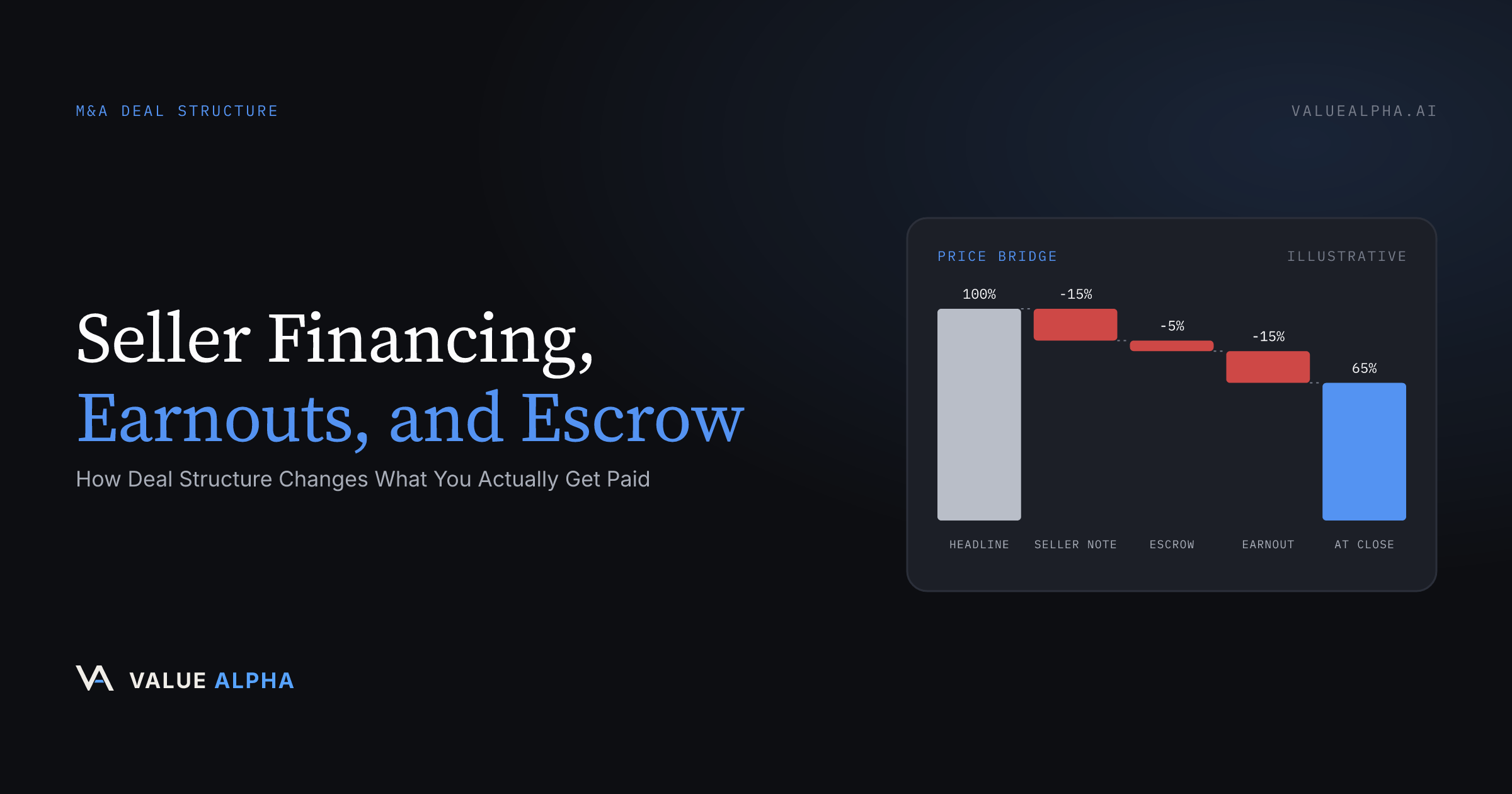
In most lower-middle-market transactions, the seller does not receive the headline price in cash at closing. A typical structure delivers roughly 60% to 80% of the price as cash at close, with the remainder split among a seller note, an escrow or indemnity holdback, and sometimes an earnout tied to future performance. Every dollar moved out of the cash column is a dollar whose payment depends on something happening after you no longer control the business.
Deal structure is the allocation of consideration across time and risk: how much is paid now, how much later, on what conditions, and who bears the loss if the business underperforms. Two offers with identical headline prices can differ by 20% or more in risk-adjusted value once structure is priced in.
Having sat on both sides of transactions, from Main Street size up to a multibillion-dollar Fortune 500 merger, the pattern is consistent: sellers negotiate price for months and structure in a weekend. That is backwards. Price is a number; structure decides whether you ever see it.
What are the components of a purchase price?
| Component | Typical share of price | Paid when | Who bears the risk |
|---|---|---|---|
| Cash at close | 60% to 80% | Closing day | Nobody, it is banked |
| Seller note | 10% to 20% | 3 to 7 years, amortizing | Seller, subordinated to the bank |
| Escrow / indemnity holdback | 5% to 15% | 12 to 24 months | Seller, against reps and warranties claims |
| Earnout | 0% to 25% | 1 to 3 years, conditional | Seller, entirely |
| Rollover equity | 0% to 30% | On the next sale | Seller, as a minority holder |
The mix moves with the buyer type. An SBA-financed individual buyer leans on a seller note because the lender requires it, a private equity platform prefers rollover equity so the operator stays invested for the second bite, and a strategic buyer paying cash usually offers the cleanest structure alongside the most aggressive reps and warranties.
Why can a higher headline price mean less money?
Because contingent dollars are not cash dollars, and the discount is steep. Consider two offers for the same business:
| Offer A | Offer B | |
|---|---|---|
| Headline price | $5,000,000 | $4,400,000 |
| Cash at close | $3,250,000 (65%) | $4,180,000 (95%) |
| Seller note | $750,000 | $220,000 |
| Escrow (18 months) | $250,000 | $0 |
| Earnout (3 years) | $750,000 | $0 |
| Probability-weighted value | ~$4,300,000 | ~$4,340,000 |
Weighting is judgment, not arithmetic, but the direction is not controversial: a reasonable seller haircuts an earnout by 40% to 60%, a subordinated seller note by 10% to 25% depending on the buyer's coverage, and an escrow by whatever they think diligence missed. Offer A is 14% higher on paper and no better in the hand. Sellers who chase the headline number are frequently choosing the worse deal, and it is the same instinct behind the gap between what owners expect and what buyers pay.
How should an earnout be designed?
Earnouts exist to bridge disagreement about the future: the buyer will not pay today for growth that has not happened, and the seller will not surrender it for free. They are also the single most litigated provision in private M&A. Four rules keep them workable.
1. Measure the cleanest possible metric. Revenue is verifiable and hard to manipulate. EBITDA runs through the buyer's chart of accounts, their overhead allocations, and their bonus decisions. Gross profit is a reasonable middle ground. If the earnout is on EBITDA, the definition needs the same rigor a Quality of Earnings report applies to the historicals, written into the agreement.
2. Keep the period short. One year is measurable and attributable. Three years means you are being paid on decisions made by someone else, in a business you no longer run, through an economic cycle nobody forecast.
3. Buy operating protection in writing. Specify what the buyer may not do during the earnout period: no reallocating your customers to a sister division, no loading corporate overhead onto your P&L, no cutting the sales spend that generates the target. Without them, an earnout is a promise with a conflict of interest attached.
4. Prefer linear over cliff. A cliff ("hit $2M EBITDA and receive $500K") produces a total loss at $1.98M and litigation at $1.99M. A sliding scale pays what the business earns and removes the incentive to fight over rounding.
How does a seller note actually work?
The seller lends part of the purchase price back to the buyer, usually at a market-adjacent interest rate, amortizing over three to seven years, and subordinated to the senior lender. Subordination is the whole story: if the business stumbles, the bank is paid, and you wait.
For SBA 7(a) buyers this is not optional in the way sellers expect. A seller note can count toward the buyer's required equity injection only if it is on full standby, meaning no payments of principal or interest for a defined period, subject to the conditions in the current SBA SOP 50 10. Sellers should confirm the standby terms with the buyer's lender before signing an LOI, because a note quoted as "$500K over five years" may be a note that pays nothing for the first two. This is one of several places where SBA financing rules shape the valuation and the structure rather than just the funding.
Three protections worth negotiating: a personal guarantee from the buyer (banks require one, so should you), acceleration on default and on resale, and a security interest in the business assets, junior to the bank but ahead of everyone else.
What should a seller do before signing the LOI?
Structure belongs in the letter of intent, alongside the price and the working capital peg. Once exclusivity is signed, leverage is gone, and every subsequent conversation about structure is a renegotiation you will lose.
- Price the structure, not the headline. Build the probability-weighted table above for every offer before you compare them.
- Fix your floor in cash. Decide the minimum cash at close that makes the transaction worth doing, and treat it as non-negotiable.
- Know your own numbers first. A defensible valuation range, built before you are in the room, is what allows you to trade structure against price deliberately rather than reactively. That is the problem ValueAlpha was built to solve for owners who do not have a banker on retainer.
Frequently Asked Questions
Is seller financing a bad sign?
No. Some seller financing is standard in small-business transactions, and lenders often require it as evidence the seller believes the business will keep performing. What matters is the share of the price it represents, the standby terms, and the protections attached to the note.
What percentage of the price should be cash at close?
Most sellers should target 70% or more in cash at closing for a healthy, transferable business. Below roughly 60%, the transaction begins to resemble a deferred sale in which you carry the risk without the control.
Can I refuse an earnout?
Yes, and the counter is usually to lower the headline price. That trade often favors the seller: a certain $4.4M frequently beats a contingent $5.0M once the earnout is properly discounted and the litigation risk is priced.
Key Takeaways
- The headline price is an opening statement; cash at close is the transaction.
- Discount contingent consideration before comparing offers: earnouts by 40% to 60%, subordinated notes by 10% to 25%.
- Earnouts work when the metric is clean, the period is short, operating covenants are explicit, and payouts slide rather than cliff.
- Under SBA 7(a), a seller note counted toward the buyer's equity injection must sit on full standby, so confirm the terms before the LOI.
- Negotiate structure inside the LOI. After exclusivity, you are renegotiating from behind.
Valuation intelligence, once a month.
Valuation insights, best practices, and market multiple trends. Delivered the first Tuesday of every month. Written for searchers, advisors, and owners who want to stay sharp.
Free · No spam · Unsubscribe anytime

Tomasz Felpel
Founder & CEO, Value Alpha
Columbia Business School MBA and founder of Value Alpha. Former Global Business Development Manager at IFF, where he contributed to a multibillion-dollar Fortune 500 merger. VP of Startup Lab at Columbia Entrepreneurship Organization.
LinkedInRelated Articles
August 7, 2026 · 8 min
The Net Working Capital Peg: The Closing-Table Fight Nobody Warns First-Time Sellers About
The NWC peg explained: why 'cash-free, debt-free' deals still move six figures at closing, how the working capital target is set, and how buyers and sellers each protect themselves.
July 27, 2026 · 8 min
Quality of Earnings vs. Valuation: What Changes Between the LOI and Closing
A valuation sets the multiple; a Quality of Earnings (QoE) report tests the earnings underneath it. Here's what QoE actually examines, the adjustments that re-price deals, and how both sides prepare.
May 29, 2026 · 7 min
The Valuation Gap: Why Owners and Buyers Price the Same Business Differently
The valuation gap is the difference between what you think your business is worth and what a buyer will pay. Here's why it happens - and how to close it before you go to market.
From Our LinkedIn
Follow us for valuation insights and industry analysis
Value Alpha
Valuing a private company should not be a black box. Upload the financials and get a defensible bear, base and bull range with every figure traced back to the document it came from. Multiple engines. Sector-specific.
Value Alpha
Not all businesses are valued the same way. A biotech with a drug pipeline needs Pipeline SOTP analysis. A manufacturing company needs asset-based valuation. An IT services firm needs comparable companies. Value Alpha calibrates engines by industry.
Value Alpha
Scenario analysis: change the debt paydown, the growth rate or the margin, and watch the range move. Every engine reruns and the drivers are shown, so you can see which assumption is carrying the value.