

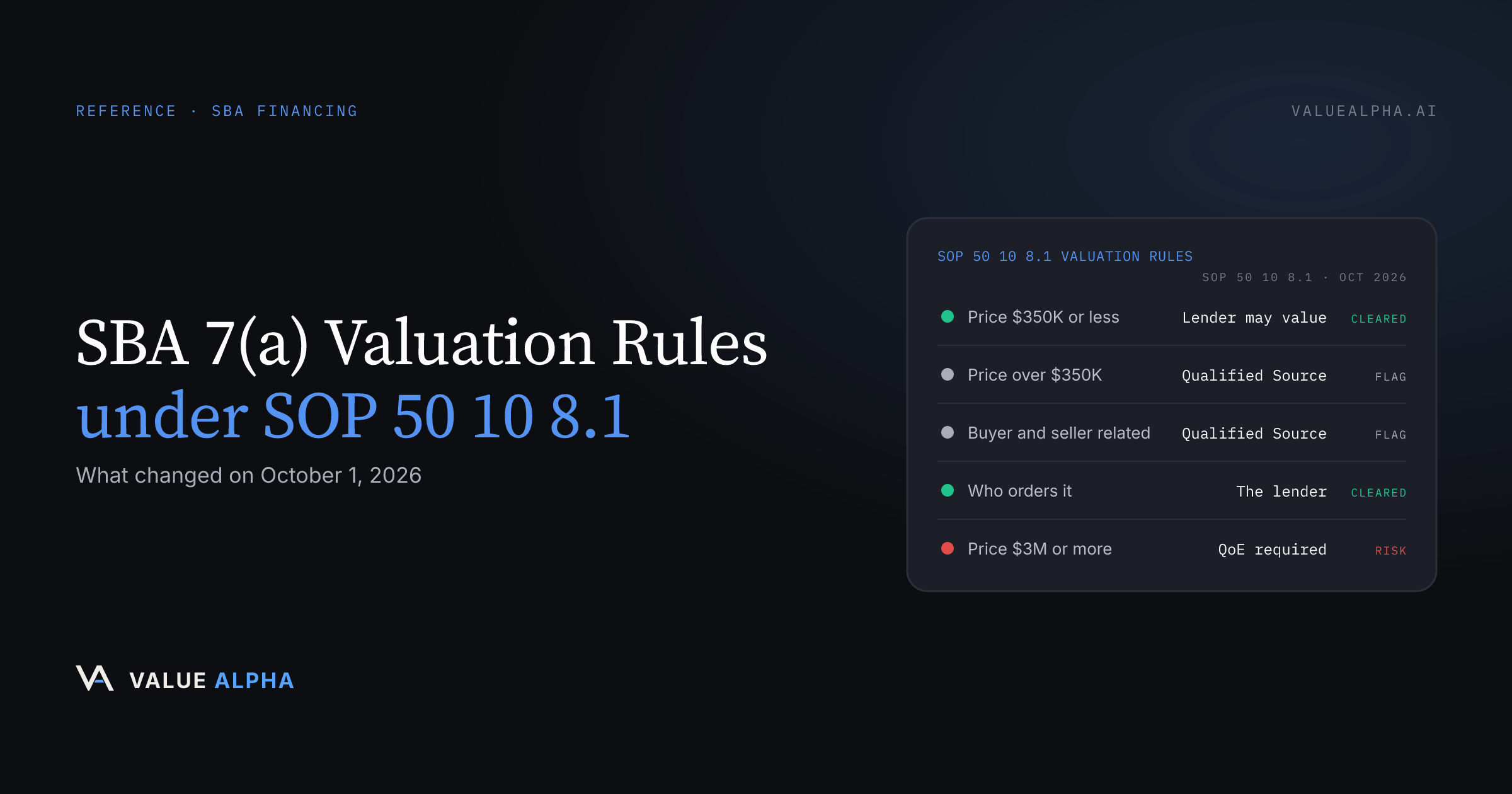
Since October 1, 2026, SBA 7(a) loans that fund a change of ownership follow SOP 50 10 8.1. The valuation rule fits in two sentences. The lender must obtain a business valuation from a Qualified Source, a credentialed appraiser the lender engages, unless the Business Purchase Price is $350,000 or less and buyer and seller have no close relationship, in which case the lender may value the business itself. Initial acquisitions and business expansions priced at $3 million or more also need a quality of earnings (QoE) report.
This article sets out those rules from the SOP's own text and what they mean for a buyer pricing a deal. They live in Appendix 15 of the SOP, "7(a) Changes of Ownership".
What Changed on October 1, 2026
| Before (SOP 50 10 8, June 1, 2025) | Now (SOP 50 10 8.1, October 1, 2026) | |
|---|---|---|
| When the lender may value the business itself | The financed amount, net of separately appraised real estate and equipment, was $250,000 or less | The Business Purchase Price is $350,000 or less, and buyer and seller are not closely related |
| What the threshold is measured on | The intangible portion being financed | The price of the business, excluding owner-occupied commercial real estate, whatever the financing |
| Quality of earnings report | No SOP requirement | Required for initial acquisitions and business expansions priced at $3 million or more |
The rest of this article describes the rules as they stand now.
Who Must Value the Business
The SOP calls the appraiser a Qualified Source: an individual who regularly receives compensation for business valuations, holds one of five credentials, is independent of the loan production function, is not involved in approving the transaction, and has no appearance of a conflict of interest.
| Credential | Issuing body |
|---|---|
| Accredited Senior Appraiser (ASA) | American Society of Appraisers |
| Certified Business Appraiser (CBA) | Institute of Business Appraisers |
| Accredited in Business Valuation (ABV) | American Institute of Certified Public Accountants |
| Certified Valuation Analyst (CVA) | National Association of Certified Valuation Analysts |
| Business Certified Appraiser (BCA) | International Society of Business Appraisers |
Try the calculator
See your VA Range in under a minute
Enter revenue, EBITDA, industry, and growth. Get a bear, base, and bull estimate from 11,000+ SMB comps. No account needed: a business name and email unlock the range.
The Lender Orders the Valuation, Not the Buyer
The valuation must be requested by and prepared for the lender. The SOP says the lender may not use a valuation prepared for the applicant or the seller. A valuation the buyer commissioned, a broker's opinion of value, or a Value Alpha report cannot be the SBA valuation, however good it is.
The report must say whether the deal is an asset purchase or a stock purchase and what the sale includes, including any debt the buyer assumes. It must carry the appraiser's conclusion of value, their qualifications, and their signature certifying the report.
The $350,000 Test
The test runs on the Business Purchase Price: the price of the business, excluding all owner-occupied commercial real estate in the deal. When real estate is part of the purchase, the lender takes its appraised value out of the contract price. The SOP measures the threshold before financing: buyer equity, seller notes and anything else that reduces the loan amount do not change it.
- Business Purchase Price of $350,000 or less: the lender may perform its own valuation, unless there is a close relationship between buyer and seller.
- Above $350,000, or buyer and seller closely related: a Qualified Source valuation, ordered by the lender.
The same $350,000 test applies when the business operates from a special purpose property, which the SOP defines as a limited-market property whose unique design, construction materials or layout restricts it to the use it was built for. There, the valuation must allocate separate values to the land, building, equipment and intangible assets, and the property is appraised by a Certified General Real Property Appraiser who has completed at least four going-concern appraisals of equivalent special use property in the last 36 months, under current USPAP guidelines.
When the Price Is Above the Valuation
The valuation must support the Business Purchase Price however the debt is structured. If the buyer pays more than the valuation, the difference must be covered by equity. Total debt behind the deal, including seller debt that is not on full standby, is capped at the valuation amount, and it must be supported by the buyer's debt service coverage.
The lender also checks the appraiser's inputs: it must obtain the financial information the appraiser relied on and verify it against the seller's IRS tax transcripts.
Quality of Earnings at $3 Million
For initial acquisitions and business expansions with a purchase price of $3 million or more, measured before buyer equity, seller debt or other financing, the lender must obtain a QoE in addition to the valuation. Owner buyouts and ESOP or cooperative transactions are exempt, because the existing owners stay in the business, and so is the purchase of an owner-occupied special purpose property.
The SOP sets what the QoE must contain:
- It is performed by an independent, experienced financial professional, for the lender's benefit, and it may not be prepared by or for the seller.
- It reconciles the accountant-prepared statements, tax returns, internal statements and IRS transcript data into a normalized figure for recurring, arm's-length earnings.
- It includes a cash proof: cash receipts and disbursements rebuilt from bank statements and reconciled to the income statement and tax return, for the trailing 12 months and the last two fiscal years.
- It documents every add-back and adjustment, including owner compensation above or below market, related-party transactions, non-recurring items, deferred maintenance, and cash-basis versus accrual differences.
- It assesses revenue quality: customer concentration, contract continuity, and whether revenue and margins are likely to hold after the sale.
A buyer who commissioned a QoE before approaching the lender can have it reviewed by one of the lender's approved vendors; the lender may not rely on another party's QoE without that review. The lender computes debt service coverage on the QoE's earnings, and if that coverage does not support the valuation and the proposed debt, the loan is reduced.
The Other Numbers Buyers Plan Around
| Initial Acquisition | Business Expansion | Owner Buyout | ESOP and Cooperative | |
|---|---|---|---|---|
| Minimum equity injection | 10% | 10% | 10% | 10% (none for an ESOP buying 51% or more) |
| Minimum debt service coverage | 1.25:1 | 1.15:1 | 1.25:1 | 1.25:1 |
| QoE at a $3 million price or more | Required | Required | Not required | Not required |
Equity is measured against total project cost, except in owner buyouts, where it is measured against the purchase price. Seller earnouts are prohibited, although a rebate to the buyer based on the business's performance is allowed. In initial acquisitions and business expansions the seller may not stay on as an owner, officer or employee, but may consult for the business for up to 24 months.
On timing: when the lender processes the loan under delegated (PLP) authority, the valuation and the QoE may be completed after the SBA loan number is issued and before closing, as long as both are formally engaged, with a vendor retained and an engagement letter signed, when the number is issued. Until they arrive, the lender's credit memorandum carries an estimate of the business's value. For applications sent to SBA for review, both go in with the application.
A Worked Example
Illustrative. A buyer agrees to pay $2,400,000 for an HVAC company, with no real estate in the deal.
- The Business Purchase Price is above $350,000, so the lender orders a Qualified Source valuation.
- The price is below $3 million, so the SOP does not require a QoE.
- The buyer injects at least 10% of total project cost. With $100,000 of closing costs and working capital, that is 10% of $2,500,000, or $250,000.
- The valuation comes in at $2,200,000. The $200,000 the buyer pays above it must be covered by equity, and total debt, including any seller note that is not on full standby, cannot exceed $2,200,000.
- As an initial acquisition, the deal must show debt service coverage of at least 1.25:1.
At a price of $3,200,000 the same deal would also need a QoE, and the lender would test the 1.25:1 coverage on the QoE's earnings, not the seller's. A QoE that strips $100,000 of add-backs from the seller's figures shrinks the loan the business can support.
Where Value Alpha Fits
A Value Alpha valuation is not the SBA valuation and cannot replace it: the SOP requires a report ordered by and prepared for the lender. What it gives a buyer is an estimate, before the LOI, of the range the business supports and whether the price clears 1.25 times debt service coverage, so a gap between price and value shows up before the lender's appraisal rather than after it. See how to set a valuation range in an LOI and quality of earnings versus valuation.
Key Takeaways
- Since October 1, 2026, SOP 50 10 8.1 governs SBA 7(a) change-of-ownership loans.
- A Qualified Source (ASA, CBA, ABV, CVA or BCA) values the business, ordered by and prepared for the lender. A valuation prepared for the buyer or seller does not count.
- The lender may value the business itself only when the Business Purchase Price is $350,000 or less and buyer and seller are not closely related.
- Paying above the valuation means covering the difference with equity; total debt is capped at the valuation.
- Initial acquisitions and business expansions at $3 million or more also need a QoE, and the lender sizes the loan on the QoE's earnings.
Source: SBA SOP 50 10 8.1, effective October 1, 2026: Appendix 15, 7(a) Changes of Ownership, and the definitions of Qualified Source and Quality of Earnings. Read it on SBA's website. This article is educational and is not legal or lending advice; confirm the requirements that apply to your loan with your lender.
Value Alpha Team
Finance & AI Experts
MBA-trained valuation professionals and engineers building the future of private company valuation. We combine institutional finance methodologies with AI to make defensible valuations accessible to every business owner.
LinkedInRelated Articles
LOIdeal structureETAsearch fundsbusiness buyersM&A advisory
How to Set a Valuation Range in an LOI: A Searcher's Guide
How searchers and self-funded buyers set a defensible LOI valuation range before diligence: the multiple bands, the four discounts to price in, and how wide to leave the range.
July 15, 2026 · 8 min
quality of earningsdue diligenceETAsearch fundsM&A advisory
Quality of Earnings vs. Valuation: What Changes Between the LOI and Closing
A valuation sets the multiple; a Quality of Earnings (QoE) report tests the earnings underneath it. Here's what QoE actually examines, the adjustments that re-price deals, and how both sides prepare.
July 27, 2026 · 8 min
ETAsearch fundsM&A advisorybusiness buyersacquisitionLOI
How to Value an Acquisition Target: A Search Funder's Framework for Setting Your LOI Range
How search fund and ETA buyers value an acquisition target: normalize SDE or EBITDA, anchor to lower-middle-market multiples, and set an LOI range a lender will underwrite.
July 20, 2026 · 11 min
From Our LinkedIn
Follow us for valuation insights and industry analysis
Value Alpha
Valuing a private company should not be a black box. Upload the financials and get a defensible bear, base and bull range with every figure traced back to the document it came from. Multiple engines. Sector-specific.
Value Alpha
Not all businesses are valued the same way. A biotech with a drug pipeline needs Pipeline SOTP analysis. A manufacturing company needs asset-based valuation. An IT services firm needs comparable companies. Value Alpha calibrates engines by industry.
Value Alpha
Scenario analysis: change the debt paydown, the growth rate or the margin, and watch the range move. Every engine reruns and the drivers are shown, so you can see which assumption is carrying the value.