

The $1M Question Every Business Owner Gets Wrong
When a buyer asks "what are your earnings?" - your answer depends entirely on which metric you use. For businesses under $5M in revenue, the wrong choice can swing your valuation by 30% or more.
SDE: The Small Business Standard
Seller's Discretionary Earnings (SDE) adds back everything the owner takes from the business: salary, benefits, personal expenses run through the company, one-time costs, and other discretionary spending. It answers the question: how much cash does this business generate for a single owner-operator?
SDE is the standard for businesses valued under $5M. Most small business buyers are individual operators who will replace the current owner - so they want to know the total economic benefit they're acquiring.
Typical SDE add-backs include:
- Owner salary and bonuses
- Owner benefits (health insurance, retirement, vehicle)
- One-time legal or consulting fees
- Above-market rent to related parties
- Personal travel and entertainment
EBITDA: The Institutional Buyer Metric
Earnings Before Interest, Taxes, Depreciation, and Amortization strips out financing decisions and accounting choices, but keeps management compensation as a real expense. It answers: how profitable is this business as a going concern with professional management?
EBITDA is standard for businesses above $5–10M in revenue, where institutional buyers (private equity, strategic acquirers) will install a management team rather than operate themselves.
Why It Matters for Valuation
The metric you choose determines which multiple applies:
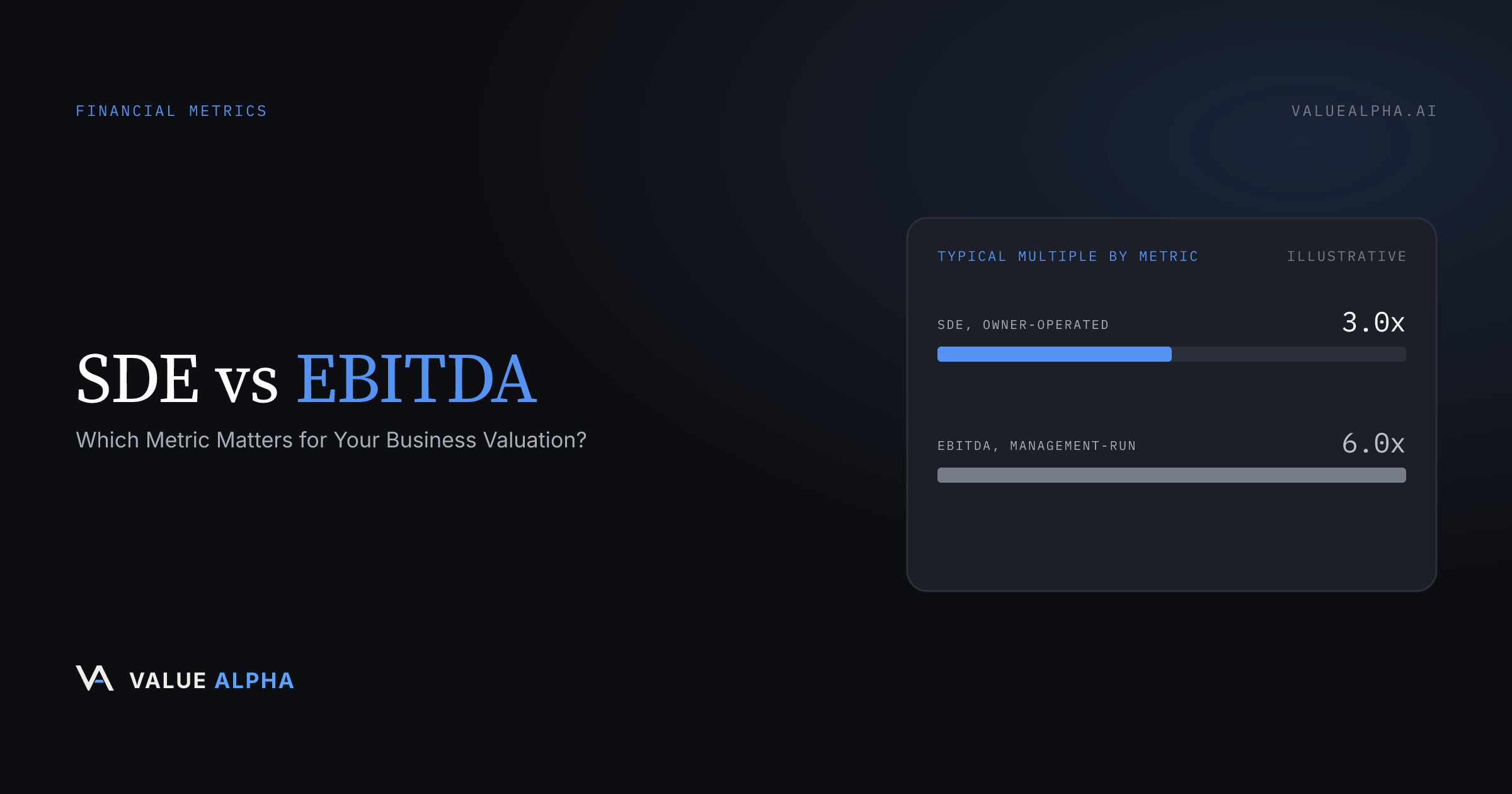
| Revenue | Metric | Typical Multiple | Example |
|---|---|---|---|
| $1–5M | SDE | 2.0–4.0x | $500K SDE × 3.0 = $1.5M |
| $5–20M | EBITDA | 4.0–8.0x | $1.5M EBITDA × 6.0 = $9.0M |
| $20M+ | EBITDA | 6.0–12.0x | $4M EBITDA × 8.0 = $32M |
Using EBITDA multiples on a $2M revenue business (where SDE is more appropriate) will systematically undervalue the company - because EBITDA doesn't capture the owner's total economic benefit.
How ValueAlpha Handles This
Our platform automatically selects the right primary metric based on your revenue size and industry. For professional services firms, we default to SDE with industry-specific normalization. For larger businesses, we use EBITDA with appropriate add-back guidance.
The result: a valuation range that reflects how real buyers would actually price your business.
Frequently Asked Questions
Is SDE higher than EBITDA?
Yes, for the same business SDE is almost always the larger number. SDE adds back the owner's full salary, benefits, and other discretionary spending, while EBITDA keeps management compensation as a real, ongoing expense and only removes interest, taxes, depreciation, and amortization. That gap is also why SDE trades at a lower multiple (2.0x to 4.0x) than EBITDA (4.0x to 8.0x or more), so the two approaches can still land on comparable valuations for a business in the range where either could apply.
How to calculate SDE from EBITDA?
Start with EBITDA and add back everything it leaves out because it assumes professional management is already in place: the owner's full salary and benefits, one-time or non-recurring expenses, and other discretionary spending run through the business. In formula form, SDE equals EBITDA plus owner's compensation, owner's benefits, one-time expenses, and discretionary expenses. For a full worked example with real numbers, see the SDE formula guide.
Are cashflow and SDE the same?
No, cash flow and SDE are related but not the same measure. SDE approximates the total cash benefit available to a single owner-operator, as noted above, but it starts from accounting net income and adds back non-cash items like depreciation without accounting for capital expenditures, working capital changes, or debt principal payments the way a true cash flow statement does. Treat SDE as a valuation proxy for owner benefit, not a substitute for a full cash flow analysis of the business.
Valuation intelligence, once a month.
Valuation insights, best practices, and market multiple trends. Delivered the first Tuesday of every month. Written for searchers, advisors, and owners who want to stay sharp.
Free · No spam · Unsubscribe anytime
ValueAlpha Team
Finance & AI Experts
MBA-trained valuation professionals and engineers building the future of private company valuation. We combine institutional finance methodologies with AI to make defensible valuations accessible to every business owner.
LinkedInRelated Articles
February 16, 2026 · 5 min
Understanding EBITDA Multiples by Industry
Learn what EBITDA multiples are, how they are used in business valuations, and what typical ranges look like across major industries including technology, healthcare, manufacturing, retail, and professional services.
February 16, 2026 · 6 min
DCF Analysis Explained for Private Companies
A clear, practical guide to discounted cash flow analysis for private companies. Learn the five key steps, how to estimate WACC without public market data, terminal value approaches, and common pitfalls to avoid.
From Our LinkedIn
Follow us for valuation insights and industry analysis
Value Alpha
Valuing a private company should not be a black box. Upload the financials and get a defensible bear, base and bull range with every figure traced back to the document it came from. Multiple engines. Sector-specific.
Value Alpha
Not all businesses are valued the same way. A biotech with a drug pipeline needs Pipeline SOTP analysis. A manufacturing company needs asset-based valuation. An IT services firm needs comparable companies. Value Alpha calibrates engines by industry.
Value Alpha
Scenario analysis: change the debt paydown, the growth rate or the margin, and watch the range move. Every engine reruns and the drivers are shown, so you can see which assumption is carrying the value.